Choosing the 2026 Best Handheld Fiber Laser Welding Machine requires more than comparing advertised laser power. Buyers should examine real welding performance, operator comfort, maintenance access, and supplier reliability. A machine that looks impressive online may struggle with thin stainless steel, reflective aluminum, or uneven workshop conditions.
This guide evaluates practical factors from a buyer’s perspective. It considers laser source quality, welding speed, penetration control, cooling design, gun weight, and interface simplicity. It also reviews compatible wire feeders, protective gas requirements, safety features, warranty coverage, and local technical support. Small details matter. A heavy welding gun can make a long production shift uncomfortable. Poor cable flexibility can slow work around corners. An unclear control panel can increase setup errors.
Performance claims need careful checking. Published power ratings do not always represent consistent production results. Test samples may differ from daily materials. There is no universal winner. A reliable choice depends on workload, material thickness, operator skill, budget, and expected service life.
Buyers should request sample welds, technical datasheets, training terms, and documented safety information before ordering. Ask how the supplier handles replacement lenses, nozzles, filters, and emergency repairs. These questions reveal more than polished product photos. This article compares leading options with a practical and evidence-based approach, while acknowledging a common weakness: specifications alone cannot predict every workshop result. Real testing still matters.
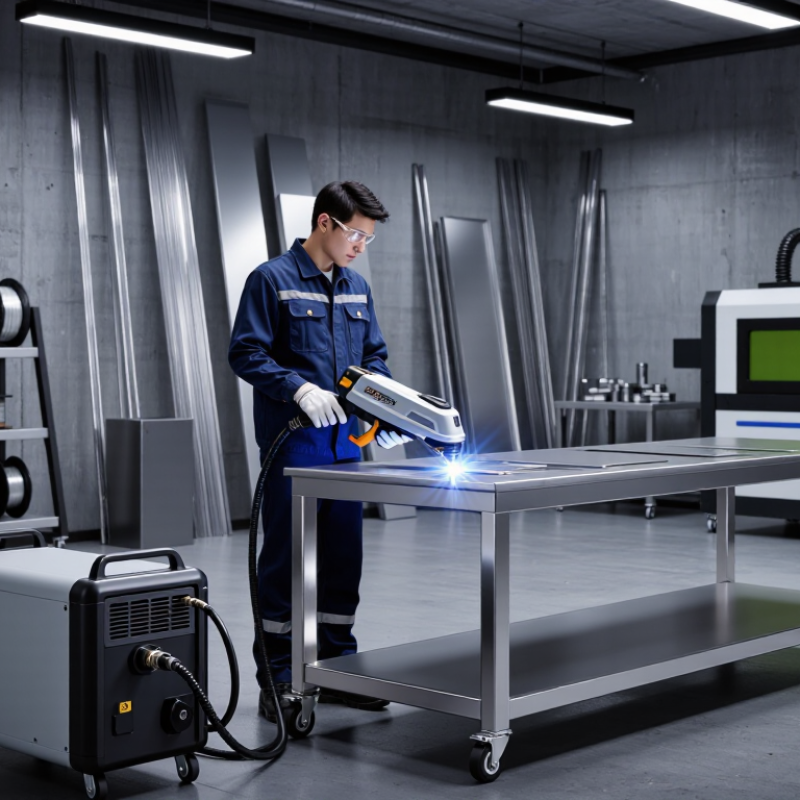
A handheld fiber laser welding machine uses a concentrated fiber-delivered laser beam to join metal parts. The beam melts the joint edges, with filler wire added when the gap requires it. Its main parts include a fiber laser source, delivery cable, focusing head, shielding-gas system, controller, and cooling unit. Many welding heads also create a small oscillating pattern, called beam wobble. This widens the fusion area and helps operators manage uneven joints.
The process is usually faster than conventional arc welding for suitable stainless steel, carbon steel, and aluminum work. It can produce a narrow bead, limited heat distortion, and less post-weld grinding. It is not magic. Joint fit-up still matters. According to MarketsandMarkets’ 2024 Laser Processing Market report, the sector may grow from 8.6 billion dollars in 2023 to 13.4 billion dollars by 2028. Grand View Research also identifies industrial material processing as a major fiber-laser application in its 2024 analysis. These figures describe broad laser markets, not every handheld machine. That distinction matters. In practical purchasing, buyers should inspect power stability, spot-size control, cable durability, gas regulation, cooling alarms, and operator protection. The beam is usually invisible near the one-micrometer wavelength. Proper guarding, interlocks, protective eyewear, and trained operation remain essential. Settings can be surprisingly sensitive. Thin sheet may burn through, while dirty surfaces can create porosity.
A handheld fiber laser welding machine converts electrical power into a concentrated light beam. Pump diodes energize a fiber source. The beam then travels through an optical fiber and reaches a focusing head. At the joint, its energy melts a tiny metal pool.
The process is fast. Very fast. A shielding gas, often argon or nitrogen, limits oxidation around the molten area. Operators adjust power, travel speed, focal position, beam wobble, and wire feed. These settings control penetration, bead width, and spatter. In practical workshop trials, poor focus can create an attractive surface but weak fusion underneath. That mistake is easy to miss.
Fiber delivery also improves flexibility around frames, cabinets, and irregular parts. However, thin stainless steel and reflective aluminum still demand careful parameter testing. A 2024 Grand View Research assessment estimated the global laser welding market at over USD 2 billion, with strong growth expected through the decade. MarketsandMarkets likewise identified automation, high productivity, and reduced heat distortion as major market drivers. These figures support buyer interest, but they do not guarantee results on every alloy.
Real performance depends on joint fit-up, operator training, extraction, protective eyewear, and verified laser safety controls. ISO 11553-1 provides relevant safety guidance for laser processing machines. A practical weakness remains: handheld operation can produce inconsistent speed and angle. Buyers should request weld samples, cross-section inspection, and documented parameter ranges before purchase. Fancy specifications are not enough.
Choosing the best handheld fiber laser welding machine in 2026 starts with specifications, not advertised power. Grand View Research’s 2024 laser welding analysis projects roughly 9% annual market growth through 2030. That expansion brings more machines, but not necessarily better machines. A 1,500-watt unit may suit thin stainless steel, while thicker mild steel can require 2,000 watts or more. Material thickness, joint design, and production speed should decide the rating.
Beam quality matters. Check the M² value, adjustable spot diameter, and welding penetration charts. A stable 0.8–2.0 mm spot can improve control around corners and narrow seams. Duty cycle is equally practical; 60% may be inadequate for continuous shop work. Water cooling, alarm functions, and temperature monitoring reduce stoppages. I would also test the wire feeder, because inconsistent wire movement quickly creates uneven beads. Small details matter.
Safety specifications deserve equal attention. IEC 60825-1 classifies laser hazards, while ISO 12100 supports machinery risk assessment. Confirm enclosure options, interlocks, emergency stops, and suitable protective eyewear. Ask for measured electrical consumption, not estimated figures. Some suppliers publish impressive penetration data under ideal laboratory conditions. Real production includes imperfect fit-up, dust, operator fatigue, and changing material batches. I still treat catalogue numbers cautiously. A hands-on trial using your actual metal, joint gap, and planned duty cycle is more reliable than a polished brochure.
| Specification | Entry-Level Profile | General-Purpose Profile | High-Productivity Profile | What Buyers Should Verify |
|---|---|---|---|---|
| Laser source type | Continuous-wave fiber laser | Continuous-wave fiber laser with adjustable parameters | Continuous-wave fiber laser with advanced process control | Confirm the rated output power, operating mode, service life specification, and replacement procedure. |
| Rated laser power | 1,000 W | 1,500–2,000 W | 2,000–3,000 W | Select power according to material, thickness, joint design, production speed, and required penetration. Published capacity is not a universal welding guarantee. |
| Typical material thickness range | Thin sheet and light fabrication; approximately 0.5–3 mm for suitable joints | Approximately 0.8–5 mm for suitable materials and joint designs | Approximately 1–8 mm for suitable materials and joint designs | Request sample welds using the exact base metal, thickness, joint type, filler wire, and production speed. |
| Common compatible metals | Carbon steel, stainless steel, and galvanized sheet with suitable settings | Carbon steel, stainless steel, aluminum, galvanized steel, and selected alloys | Carbon steel, stainless steel, aluminum, galvanized steel, copper, and selected alloys with process validation | Verify reflectivity limits, pre-cleaning requirements, shielding-gas settings, and approved welding procedures for each metal. |
| Laser wavelength | Approximately 1,070 nm | Approximately 1,070 nm | Approximately 1,070 nm | Confirm the wavelength, optical output specification, and compatibility of protective windows and lenses. |
| Wobble or beam-scan width | Typically adjustable up to approximately 4 mm | Typically adjustable up to approximately 5 mm | Typically adjustable up to approximately 6 mm or according to the optical head design | Check the actual scan range, scan pattern options, maximum scan frequency, and effect on heat input. |
| Welding speed | Up to approximately 60 mm/s under suitable conditions | Up to approximately 80 mm/s under suitable conditions | Up to approximately 120 mm/s under suitable conditions | Treat maximum speed as a reference value. Compare tested speed at the required penetration, appearance, and defect rate. |
| Wire feeder | Optional or integrated single-wire feeder; commonly 0.8–1.2 mm wire | Integrated feeder; commonly 0.8–1.2 mm wire | Integrated feeder with adjustable feed speed; commonly 0.8–1.6 mm wire | Confirm supported wire diameters, feed-speed range, liner type, spool size, and replacement-part availability. |
| Cooling method | Air cooling or compact water cooling, depending on configuration | Closed-loop water cooling is commonly preferred for continuous operation | Closed-loop water cooling with higher thermal capacity | Check cooling capacity, temperature range, flow alarms, coolant type, ambient-temperature rating, and maintenance requirements. |
| Electrical input | Single-phase or three-phase input, depending on the complete system | Usually three-phase input for stable continuous operation | Usually three-phase input with higher rated current | Confirm voltage, frequency, phase requirement, rated current, circuit protection, plug type, and local electrical compliance. |
| Handheld welding gun weight | Approximately 0.7–1.0 kg, excluding cable assembly | Approximately 0.8–1.2 kg, excluding cable assembly | Approximately 0.8–1.5 kg, excluding cable assembly | Ask for the complete working weight, cable bend radius, handle balance, trigger design, and ergonomic test information. |
| Control interface | Basic touchscreen with preset parameters | Touchscreen with material, thickness, wire, and gas parameter libraries | User accounts, parameter locking, recipe storage, alarms, and production records | Verify password protection, parameter export, language options, software updates, and recovery after power interruption. |
| Protective gas | Argon or argon-based shielding gas | Argon or approved argon-helium mixtures, according to the material | Programmable gas-delay and flow settings for repeatable production | Confirm recommended gas purity, flow range, regulator requirements, nozzle design, and gas consumption. |
| Safety functions | Key switch, emergency stop, protective-gas monitoring, and contact safety | All entry-level functions plus door or area interlock compatibility | Enhanced interlocks, fault logging, access control, and external safety-circuit integration | Confirm compliance with applicable laser, machinery, electrical, and workplace-safety requirements. A handheld laser is not automatically safe for open-floor use. |
| Laser safety classification | High-power industrial laser system requiring controlled access and protective measures | High-power industrial laser system requiring a documented safety assessment | High-power industrial laser system requiring engineered controls and trained operators | Request the laser classification, risk assessment guidance, interlock diagram, protective eyewear specification, and operator-training requirements. |
| Fume and plume control | Local extraction recommended for intermittent work | Dedicated laser-welding fume extractor recommended for regular use | Engineered extraction system sized for production duty cycle | Evaluate fumes from coatings, galvanized surfaces, stainless steel, and filler metals; specify filtration and airflow requirements. |
| Recommended duty cycle | Intermittent or light-duty production | Regular workshop and medium-duty production | Continuous or high-duty production with planned maintenance | Compare rated duty cycle, thermal derating, warm-up time, alarm history, and performance during a full production shift. |
| Maintenance items | Protective lens, nozzle, gas lens, coolant, and wire-feeder components | All entry-level items plus filters, seals, and calibration checks | All standard items plus documented preventive-maintenance intervals and spare-part stock | Obtain a maintenance schedule, spare-parts list, consumable prices, service response time, and technical documentation. |
| Best use case | Repair work, prototypes, light sheet-metal fabrication, and occasional welding | General fabrication, cabinets, frames, furniture, automotive parts, and regular workshop production | Heavy fabrication, longer welds, higher throughput, and multi-shift production | Choose based on total cost per finished weld, not laser power alone. Include electricity, gas, consumables, labor, extraction, and downtime. |
Note: Performance ranges are indicative buyer-screening values. Actual results depend on material grade, thickness, joint preparation, shielding gas, filler wire, operator technique, optics, and verified welding procedures.
Buyers should compare performance, cost, and safety under the same workshop conditions. A 1,500-watt source may weld thin stainless steel quickly, but power alone proves little. Ask for test welds on your actual materials and thicknesses. Check penetration, bead width, distortion, and cleaning time. Measure them. Beam quality, wire feeding, wobble control, and cooling stability also affect daily output. Numbers need context.
Purchase price is only one part of ownership cost. Include electricity, protective lenses, nozzles, shielding gas, maintenance, training, and downtime. A cheaper machine may need frequent adjustments or costly replacement parts. Request a written warranty, service response time, spare-parts availability, and electrical requirements. Compare the cost per finished weld, not the price on the quotation. My comparison can still miss hidden labor costs, especially when operators need extra setup time.
Safety requires more than protective eyewear. Confirm the machine’s laser classification, enclosure options, interlocks, emergency stop, warning indicators, and compatible wavelength-rated eyewear. A controlled work area and suitable fume extraction are essential for different metals and coatings. Operators should receive documented training and follow local workplace rules. During a demonstration, inspect cable protection, grounding, cooling alarms, and access controls. If a supplier avoids these questions, performance claims deserve careful review.
Choosing the best handheld fiber laser welding machine starts with the application, not the advertised power. For thin stainless steel, carbon steel, aluminum, and galvanized sheets, buyers should compare penetration, heat distortion, joint appearance, and operator control. The MarketsandMarkets Laser Welding Market report projects growth from about USD 2.7 billion in 2023 to USD 5.5 billion by 2028. That expansion reflects wider use in automotive parts, sheet-metal fabrication, kitchen equipment, and repair work. A 1,500-watt unit may suit many light and medium jobs, but thicker materials require verified test samples.
Maintenance is less glamorous. It decides uptime. Inspect the protective lens before every shift, clean the nozzle with approved tools, and keep cooling water within the supplier’s specified temperature range. Dust around the welding head can create uneven seams or lens damage. The U.S. Department of Energy notes that preventive maintenance can reduce industrial equipment downtime, although actual savings vary by workshop. Do not trust a single percentage. Your dust, workload, and operator training matter more.
Useful accessories include spare protective lenses, copper nozzles, wire-feeding equipment, a stable chiller, and fume extraction. An enclosed or screened work area is also essential. IEC 60825-1 requires laser safety classification and control measures, while ANSI Z136.1 provides practical guidance for industrial laser use. In real workshops, an attractive machine can disappoint when its replacement parts arrive slowly. I would test weld quality, consumable availability, cleaning access, and service response before purchase. The catalog rarely shows those problems.
It joins metal parts using a concentrated laser beam delivered through an optical fiber. The beam melts the joint edges. Filler wire may help bridge larger gaps. Typical components include a laser source, focusing head, cooling unit, controller, and shielding-gas system.
It commonly welds stainless steel, carbon steel, and aluminum. Results depend on thickness, cleanliness, joint design, and settings. Reflective aluminum may require careful testing. Do not assume one preset works for every alloy.
Electrical power energizes a fiber laser source. The beam travels through a delivery cable and reaches the focusing head. Its heat forms a small molten pool at the joint. Shielding gas reduces oxidation around the weld.
Suitable work can be faster than conventional arc welding. The weld bead is often narrow. Heat distortion and post-weld grinding may be reduced. That sounds excellent, but joint fit-up still matters.
Check laser power, beam quality, spot-size adjustment, duty cycle, and cooling performance. A 1,500-watt unit may suit thinner stainless steel. Thicker mild steel may need higher power. Use material thickness and production speed as your guides.
Water cooling helps control heat during repeated welding. Temperature monitoring can warn operators before overheating causes damage. Cooling alarms may reduce unexpected stoppages. Small alarms can prevent expensive interruptions.
Yes. Poor focus may create an attractive surface with weak fusion underneath. Inconsistent travel speed or angle can also reduce quality. Dirty metal may produce pores. A shiny bead is not proof of strength.
The laser beam may be invisible near the one-micrometer wavelength. Use suitable protective eyewear, guarding, interlocks, and emergency stops. Operators need practical training and controlled work areas. Visibility is not safety.
Request weld samples using your actual metal, thickness, and joint gap. Inspect bead appearance and, when possible, cross-sections. Test the wire feeder for smooth movement. Catalogue penetration figures may look better than workshop results.
Choosing the 2026 best Handheld Fiber Laser Welding Machine requires more than comparing price tags. This equipment uses a focused fiber laser beam to create precise, low-distortion welds at high speed, making it suitable for metals such as stainless steel, carbon steel, aluminum, and other compatible materials. Buyers should evaluate laser power, welding thickness range, beam quality, control interface, cooling method, portability, electrical requirements, and compatibility with different joint designs.
A reliable purchasing decision should balance performance, total operating cost, serviceability, and workplace safety. Consider energy consumption, consumable parts, maintenance access, training requirements, protective systems, and compliance with applicable safety standards. Practical applications may include fabrication, repair, custom metalwork, enclosures, furniture, automotive components, and general manufacturing. Useful accessories can include specialized nozzles, wire-feeding equipment, protective windows, fume extraction, suitable eye protection, and workholding tools. The best model is the one that matches production needs while delivering consistent weld quality, manageable maintenance, and safe long-term operation.