Choosing among the Top 10 Gantry Robot Systems requires more than comparing prices or advertised speed. Buyers must match the machine to the job: a wide gantry spanning a production cell has different demands from a compact unit loading a CNC machine. Payload, travel length, repeatability, cycle time, floor space, and service access all affect real-world performance. Fit matters.
Industry data shows why automation decisions deserve careful scrutiny. The International Federation of Robotics’ World Robotics 2023 reported 553,052 industrial robots installed worldwide in 2022. Its World Robotics 2024 report recorded 541,302 installations in 2023 and more than 4.28 million robots in operation. These figures cover industrial robots broadly, not gantry systems alone. Still, they show the scale of investment buyers are weighing. Details matter.
Robotics researcher Rodney Brooks wrote, “The world is its own best model.” That principle suits gantry selection: evaluate the actual workpiece, machine layout, and operating environment, not just a specification sheet. A system that looks efficient on paper may lose time through awkward loading or difficult maintenance. This guide compares leading options for global buyers, with attention to applications, configuration, integration, and support. It cannot replace a site assessment. Even experienced teams can overlook a constraint. The best choice is the one that fits the process reliably—and leaves room for what the line may need next.
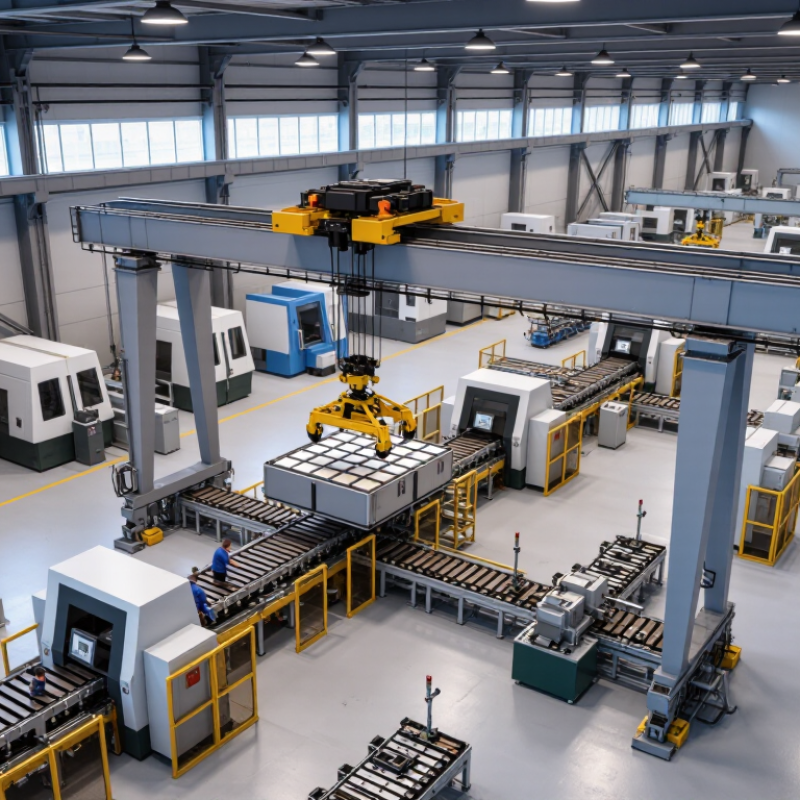
A gantry robot system moves a tool or gripper along straight, coordinated axes, usually above a machine, conveyor, or work area. Think of a carriage sliding across overhead rails, then lowering a part with a vertical axis. Its rectangular work envelope suits loading, palletizing, and moving heavy or repetitive items. That is the basic motion. A controller follows programmed coordinates, while sensors and position feedback help confirm where the carriage is. The end effector matters: a vacuum cup may lift a flat carton, while mechanical fingers can grip a metal component.
The International Federation of Robotics reported 541,302 industrial robot installations worldwide in 2023, with an operational stock of about 4.28 million, in World Robotics 2024. Those figures cover industrial robots broadly, not gantry systems alone, so they show automation’s scale rather than gantry-specific adoption. In practice, engineers map the load, reach, cycle time, and obstacles before setting axis speeds. A small alignment error can become a dropped part or a jammed line. Not quite plug-and-play. Rail stiffness, cable routing, and gripper changes can also affect performance. A commissioning team should test real parts across repeated cycles, not just watch an empty carriage move. I have seen the simplest-looking transfer become the one that needs more adjustment.
A gantry robot’s performance depends on how its parts work together. The frame carries the load, while linear guides and drive units move the carriage along each axis. A vertical Z-axis slide positions the tool; the end effector may grip cartons, machine parts, or layered sheets. Motors, encoders, and a motion controller coordinate travel and repeatability. Cable routing and guarding matter too. A snagged cable can interrupt a precise cycle.
Common layouts include Cartesian XYZ systems, two-axis overhead gantries, and multi-carriage designs serving several workstations. Choose based on part size, reach, payload, and required cycle time. The International Federation of Robotics reported 541,302 industrial robot installations worldwide in 2023 in World Robotics 2024. This figure covers industrial robots broadly, not gantry systems alone, but it signals the scale of automation demand. A gantry’s long reach can suit large work areas; however, a heavy frame may consume valuable floor space. That trade-off deserves an actual site measurement.
Tips: Measure the full travel envelope, not just the part. Check payload at maximum reach, including the tool and cables. Keep it simple. Leave room for maintenance access, and verify cycle times with representative parts before finalizing the layout. Some projects still underestimate dust, vibration, or awkward loading angles. Worth a second look.
A gantry robot should be assessed against the actual job, not just its advertised speed. Record payload, reach, duty cycle, positioning accuracy, and the longest expected travel distance. Then test a representative part, including its heaviest and most awkward orientation. Small details matter. IFR’s World Robotics 2023 reported 553,052 industrial robot installations in 2022; its 2024 edition reported 541,302 in 2023. These figures show broad adoption, but they do not prove that one system suits every factory.
For global use, check the complete installation: floor flatness, ceiling clearance, power supply, communications, guarding, and local maintenance capability. Ask for cycle-time results under your real load, not an unloaded demonstration. Confirm which safety standards and documentation apply at the destination, and have qualified local professionals review the integration. IFR reported that Asia accounted for about 70% of new installations in 2023, so service access and spare-part lead times deserve careful attention across regions.
Compare total operating cost, including commissioning, training, tooling, and downtime—not only purchase price. Check whether manuals, diagnostics, and operator training are available in languages your team can use. I would also ask the supplier to disclose test conditions; small inconsistencies can distort comparisons. No spreadsheet catches every surprise. A trial run with real parts often reveals cable routing or maintenance access problems that specifications miss.
Global buyers comparing the top 10 gantry robot systems should start with the workpiece, not the catalog. Measure its weight, dimensions, travel distance, and required placement accuracy. A system that handles a small carton may struggle with a heavy metal fixture. Small details matter.
Ten common configurations include Cartesian, bridge, overhead, floor-mounted, aluminum-frame, steel-frame, modular, cleanroom-ready, high-payload, and high-speed gantries. Each suits different conditions. Bridge designs can cover wide work areas, while floor-mounted systems may fit compact production cells. Steel frames often support heavier loads; lighter profiles can simplify installation. Cleanroom use calls for careful attention to materials and particle control. There is no universal winner.
Before choosing, buyers should compare payload ratings at full extension, repeatability, operating speed, and maintenance access. Ask suppliers for cycle-time estimates based on the actual load and path. Check voltage, guarding, documentation, and local service availability. These details vary by installation. A fast machine on paper may slow down when operators need to reach its components. I would also question any ranking that ignores commissioning and spare parts; those costs are easy to overlook. And specifications are not the whole story. Request relevant test data, then verify it against your production needs.
Representative payload examples across common gantry robot applications. Actual capacity depends on the robot design, reach, speed, and end effector.
Values are indicative engineering examples for comparing application types, not specifications for a particular system.
Gantry robot systems suit long travel distances, heavy payloads, and repeatable transfers between machines. Common applications include palletizing, CNC tending, packaging, and moving components across wide work cells. The International Federation of Robotics reported 541,302 industrial robot installations worldwide in 2023, in World Robotics 2024. That figure covers industrial robots broadly, not gantry systems alone. It signals a growing automation base, but does not prove that a gantry design fits every factory. Check part weight, reach, cycle time, and floor space using real production samples.
Integration starts with the physical details: ceiling height, rail supports, cable routing, guarding, and access for maintenance. A long axis can save floor space, yet complicate installation and servicing. Small misalignments matter. Buyers should ask for documented load, repeatability, and duty-cycle limits, then test the proposed layout against actual shifts and changeovers. Ownership costs include tooling, spare components, operator training, energy, and planned downtime—not just purchase price. A spreadsheet may still miss awkward part changes or cleaning needs. That deserves a pilot. Track cycle time, stoppages, and maintenance hours before expanding, and retain access for technicians to reach motors, bearings, and sensors safely.
| System type | Typical applications | Key integration considerations | Ownership considerations | Best suited when |
|---|---|---|---|---|
| 1. Three-axis Cartesian gantry | Pick-and-place, machine tending, palletizing, and repetitive transfers across a rectangular work area. | Coordinate travel, tooling, guarding, and controller signals with the production line; confirm the required reach, payload, speed, and positioning accuracy for the actual task. | Plan for routine inspection of rails, bearings, belts or screws, cable carriers, and lubrication points, as applicable to the design. | The work is repetitive and the machine needs predictable, orthogonal motion over a defined area. |
| 2. Two-axis overhead gantry | Transfers between stations, material handling, and servicing multiple machines from above. | Check building structure and runway support, overhead clearances, access for maintenance, and safe separation from people and other equipment. | Structural installation and access equipment can affect initial and ongoing costs; include inspection of the runway and moving components in the maintenance plan. | Floor space is limited and loads need to travel across a broad overhead area. |
| 3. Floor-mounted gantry | Machine loading, assembly, inspection, and handling parts across a production cell. | Evaluate floor flatness, anchoring, foundation capacity, traffic routes, and the effect of the gantry footprint on operator access. | A dedicated foundation or anchored frame may be needed; accessible rails and drive components can simplify service work. | Overhead support is impractical, but the floor layout can accommodate a fixed frame. |
| 4. Wall-mounted gantry | Handling operations along a wall, servicing equipment, and moving items within a constrained production area. | Verify wall structure, bracket loads, mounting alignment, reach, and clearance from nearby machinery and walkways. | Access to wall-mounted drives and utilities should be considered before installation; inspect mounting points and fasteners as part of planned maintenance. | A limited footprint makes a floor-supported frame undesirable and the supporting structure is suitable. |
| 5. Telescopic-axis gantry | Reaching into deep work areas, loading enclosed machines, and transferring parts across obstacles. | Account for the extended and retracted envelope, tool orientation, deflection, cable routing, and collision zones throughout the full motion. | More complex moving sections can increase inspection and service needs; confirm access to telescoping guides and utilities. | The work requires reach beyond the gantry’s supporting structure or into an enclosed station. |
| 6. Dual-carriage gantry | Independent handling tasks, coordinated transfers, or increased throughput on a shared runway. | Define carriage travel limits, collision prevention, task sequencing, control ownership, and safe operating zones for each carriage. | Additional drives and controls can increase commissioning and maintenance effort; assess whether the throughput gain justifies the added complexity. | Two tasks must use the same travel area and the process can benefit from parallel or coordinated motion. |
| 7. Gantry with rotary wrist | Part orientation, machine tending, packaging, and loading where the tool must turn or present a part at an angle. | Check wrist payload and inertia, cable or hose routing, orientation limits, tool-center-point setup, and collision clearance. | Rotary components and end-of-arm tooling add service items; provide space and procedures for tool changes and calibration. | Linear travel alone cannot achieve the required part or tool orientation. |
| 8. Cleanroom-configured gantry | Handling in controlled environments where airborne particles, materials, or outgassing must be managed. | Specify the facility’s cleanliness requirements and assess materials, lubrication, cable management, covers, and particle-control measures with the system integrator. | Cleaning methods and maintenance materials must be compatible with site requirements; verify that service activities do not compromise the controlled environment. | The process or product requires operation in a controlled environment; suitability must be confirmed against the facility’s specific classification and procedures. |
| 9. Heavy-duty gantry | Handling large workpieces, fixtures, or assemblies in manufacturing and industrial processing. | Engineer the frame, supports, drives, end effector, and foundation for the complete load and motion profile; verify deflection and stopping behavior. | Installation, structural inspection, and replacement of heavy components can require specialized equipment and planned downtime. | Loads or operating conditions exceed what a lighter standard frame is designed to handle. |
| 10. Long-travel gantry | Serving multiple stations, moving materials along extended production lines, and handling large-format work. | Plan runway alignment, structural support, power and data distribution, positioning references, end stops, and safeguarding over the entire travel path. | Long travel can make alignment checks, cable management, and access to remote sections important maintenance planning topics. | The process spans a large area and multiple stations must be served by one handling system. |
It moves a tool or gripper along straight axes, often above a machine or conveyor. Think of a carriage sliding on overhead rails.
A controller follows programmed coordinates. The carriage travels across the work area, then a vertical axis lowers the tool. Sensors help confirm its position.
The frame supports the load, while guides, drives, motors, and encoders coordinate movement. The end effector grips the part. Cable routing matters too.
Cartesian XYZ, two-axis, and multi-carriage layouts suit different jobs. Compare reach, payload, part size, and cycle time. Measure the actual site.
Check floor flatness, ceiling clearance, power, communications, guarding, and maintenance access. A heavy frame can take valuable floor space. Measure twice.
Run repeated cycles with representative parts, including heavy or awkward items. Test at maximum reach, not only with an empty carriage. Real parts reveal problems.
Misalignment, vibration, dust, or snagged cables can affect operation. A changed gripper may also require adjustments. Small details, big trouble.
Include commissioning, training, tooling, maintenance, and possible downtime—not only the purchase price. Ask for cycle-time results under realistic loads.
Check local service access, spare-part lead times, usable manuals, and operator training. Have qualified local professionals review the integration. I may be overthinking one detail, but test conditions deserve scrutiny.
A Gantry Robot System uses a moving bridge, carriage, and tooling to position or handle items across a defined work area. Its performance depends on how key components—such as axes, drives, controllers, end effectors, and safety features—work together. Common configurations vary in the number and arrangement of axes, payload capacity, reach, and mounting style, making it important to match the system to the task rather than choose by size alone.
This overview compares ten types of gantry robot systems for global buyers and explains how to evaluate them for precision, speed, reliability, serviceability, and integration needs. It also considers practical applications, connection with existing equipment, installation, operator training, maintenance, and total ownership costs. By weighing these factors against production goals and site requirements, buyers can identify a suitable system and plan for dependable long-term operation.