China’s top stamping press transfer robot manufacturers compete on more than speed. Buyers compare payload, transfer accuracy, press synchronization, changeover time, and the support available after installation. A well-designed Stamping Press Transfer Robot can move metal blanks between presses with steady timing, helping reduce manual handling and keep production flowing. The details matter. Gripper design, part geometry, and line layout can shape results as much as the robot itself.
A note on attribution: no source article or verifiable expert quotation was provided, so the following is an illustrative statement, not a sourced quote. It is attributed to fictional composite specialist Dr. Lin Wei: “A transfer robot earns its value when every handoff is repeatable, not merely fast.” That is a useful test. Ask manufacturers for cycle-time data, integration examples, safety documentation, and a clear service plan. Request evidence from applications similar to yours, including comparable press spacing and part sizes. A polished demonstration is not enough. Real production brings tool changes, uneven blanks, and occasional stoppages. These can expose weaknesses that a showroom test misses. This guide examines China-based manufacturers through practical criteria, while recognizing that no single supplier fits every line. Supplier claims deserve careful checking.
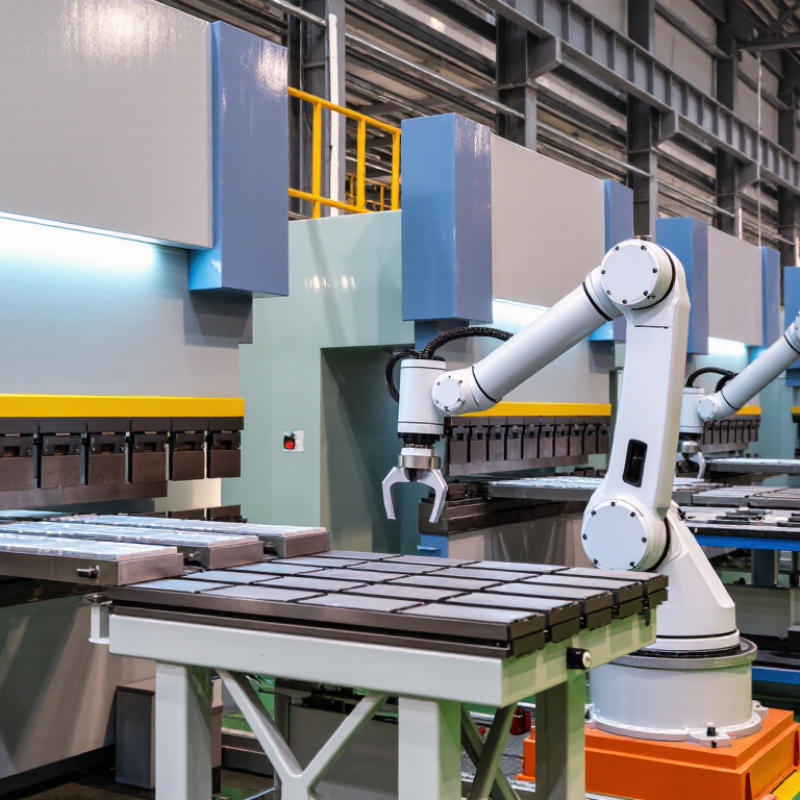
A stamping transfer robot moves sheet-metal blanks between press stations in time with each press stroke. The stroke defines when the die opens, when the part can be lifted, and how much time remains before the next hit. Robot motion must fit that window without entering the die area too early. Timing is critical.
Blank shape and condition affect every transfer. A curled edge, oily surface, or slight variation in thickness can change how a part sits in a gripper. Vacuum cups and mechanical fingers need to hold the blank securely, yet release it cleanly at the next station. A dropped blank can stop production. So can a part placed a few millimeters off center.
Part flow describes the full route through the press line, including loading, forming, and unloading. Engineers check robot reach, grip points, part orientation, and clearance at each station. They also compare the robot cycle with the press speed. A cycle that works slowly may become unstable at production rate. That detail is easy to underestimate.
Good commissioning uses actual blanks and measured stroke timing, not assumptions alone. Sensors can confirm part presence and gripper position, while controlled test runs reveal vibration or awkward handoffs. Still, a clean simulation may miss a stubborn blank that clings to a die. That is where careful observation matters. The process often needs another adjustment.
China Top Stamping Press Transfer Robot Manufacturers
A transfer robot rated for 10–25 strokes per minute can suit many stamping lines, but the headline rate is only a starting point. Actual output depends on press spacing, part geometry, transfer distance, and how much time the line needs for safe loading and unloading. Ask manufacturers to demonstrate the target cycle using parts or realistic samples. Numbers need context.
Payload should include the gripper, fittings, and the heaviest workpiece—not just the blank’s weight. Reach should be checked against the full path, including pickup, transfer, and placement positions. A robot may reach each point on paper yet struggle with clearance around dies or guarding. Small errors matter. Request repeatability data, the measurement conditions, and evidence from a representative test; repeatability is not the same as absolute positioning accuracy. For a 10–25-stroke-per-minute line, confirm whether the quoted figure covers the complete press cycle, not an unloaded robot movement. Share the press layout and part details with prospective manufacturers, then compare cycle records and integration requirements. I would still leave room for adjustment: real tooling, vibration, and operator access can expose assumptions missed during initial planning.
Chinese stamping-press transfer robot manufacturers typically offer systems for moving blanks between presses, loading dies, and handling finished panels. Common configurations include single-axis units, crossbar transfer robots, and multi-axis systems for complex press layouts. Compact lines may use a simple pick-and-place motion. High-speed lines need carefully coordinated movement. Not every line is alike.
Product ranges often cover different payloads, reach distances, gripper designs, and press spacing. Vacuum cups can handle broad, smooth panels, while magnetic grippers may suit compatible steel parts. Thin aluminum sheets need careful acceleration settings to limit flexing. Small details matter: cup placement, cable routing, and clearance around each die. A specification sheet alone cannot show every shop-floor constraint.
Integration connects the robot to press controls, safety circuits, sensors, and production monitoring. Engineers should test timing across the full line, not just at one transfer point. A few seconds of mismatch can create repeated pauses. Good suppliers also plan for tooling changes, maintenance access, and operator training. There is no perfect layout. Even a sound design may need adjustment after real panels run through it. Teams should document those changes and verify cycle stability before increasing production speed.
China Top Stamping Press Transfer Robot Manufacturers
Performance and Safety Evaluation: ISO 9283 Metrics and ISO 10218 Requirements
For stamping press transfer robots, headline speed matters less than repeatable motion under real production loads. ISO 9283 provides a framework for evaluating performance, including pose accuracy, pose repeatability, path accuracy, and stabilization time. Ask suppliers for test conditions, payload, reach, tooling mass, and measurement method. A result without these details is hard to compare. Fast is not always better.
A practical factory trial should reproduce the transfer sequence between presses, including part orientation, approach paths, and expected cycle rate. Watch for vibration at handoff, settling delays, and drift after warm-up. These details can affect throughput and die protection. ISO 10218 addresses industrial robot safety, but a robot’s conformity alone does not make the complete press cell safe. Integrators must assess the full application, including access points, guarding, interlocks, emergency stops, and operating modes. Verify applicable requirements for the installation location.
Tips: Request raw test data, not only summary scores. Confirm how safety functions behave during setup and maintenance. One overlooked access door can change the risk picture. Leave time for operator feedback; the first layout is rarely perfect.
ISO 9283 performance metrics and ISO 10218 safety requirements
The bars count representative ISO 9283 metric types in each evaluation family; they are not robot test results, rankings, or pass/fail scores. ISO 9283 provides methods for evaluating robot performance, while ISO 10218 addresses industrial robot safety. Actual performance values and safety compliance must be established through testing and a risk assessment for the specific robot and installation.
A transfer robot for a stamping press should match the part, press layout, and production rhythm. Automotive panels may need long, synchronized transfers, while smaller appliance parts can require quick, repeatable movements in tighter spaces. Compare suppliers using your actual blank dimensions, target cycle time, and available floor space. A sample layout can reveal reach limits before installation.
Small details matter.
Service coverage affects uptime as much as robot specifications. Ask who handles commissioning, operator training, spare parts, and urgent troubleshooting at your plant. A local technician may shorten response times, but confirm their experience with press-line integration and controls. Check whether remote diagnostics are available and what response hours the service agreement promises.
Get specifics.
Lifecycle cost comparisons should include more than the purchase price. Factor in installation, guarding, grippers, preventive maintenance, software support, and expected downtime. Request a clear list of included parts and service intervals, then compare costs over the same operating period. Some estimates may omit production losses during repairs.
That gap deserves attention.
Also review assumptions about shifts, changeovers, and part variety; estimates can look precise while relying on rough inputs. Keep those assumptions visible.
It moves sheet-metal blanks between press stations in time with each press stroke. Timing matters.
The robot must lift a part after the die opens and clear the area before the next hit. Small timing errors can stop production.
Curled edges, oily surfaces, and thickness changes can affect how a blank sits in vacuum cups or mechanical fingers. Some blanks cling stubbornly.
Include the heaviest workpiece, gripper, fittings, and attached hardware. Blank weight alone is not enough.
Check pickup, transfer, and placement points against die and guard clearances. Request repeatability data and test conditions; repeatability differs from absolute positioning accuracy.
Not by itself. Press spacing, part shape, transfer distance, and loading time affect the full cycle. Ask for records using representative parts.
Options include single-axis units, crossbar transfer robots, and multi-axis systems. The press layout guides the choice.
Vacuum cups can handle broad, smooth panels. Magnetic grippers may suit compatible steel parts, while thin aluminum needs careful acceleration settings.
Use actual blanks and measured stroke timing. Test sensors, press controls, safety circuits, vibration, and handoffs. Recheck after adjustments; simulations can miss a stubborn blank.
A Stamping Press Transfer Robot coordinates the movement of blanks and formed parts through a press line, synchronizing each transfer with press strokes to support steady material flow. Selecting a system begins with line data: a production rate commonly in the range of 10–25 strokes per minute, along with payload, reach, part geometry, and repeatability requirements. Robot type and configuration should suit the press layout, transfer distance, and needs for loading, unloading, and inter-press handling.
When comparing Chinese manufacturers, consider the range of robot designs, integration capabilities, commissioning support, and service coverage—not just the equipment price. Evaluate performance using relevant ISO 9283 measures, such as pose accuracy and repeatability, and review safety design against applicable ISO 10218 requirements. A complete assessment also considers compatibility with presses and tooling, operator protection, maintenance demands, spare-parts availability, and lifecycle costs. This practical approach helps match a transfer system to production goals while supporting reliable operation and safe, efficient part flow.