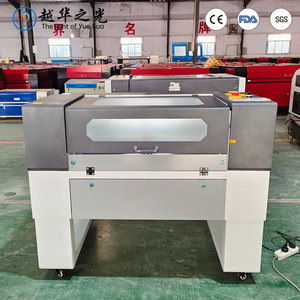
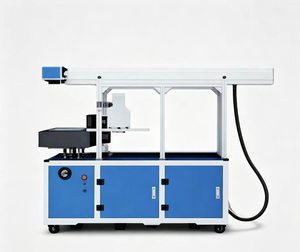
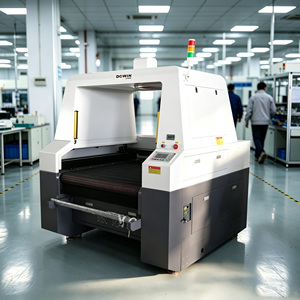
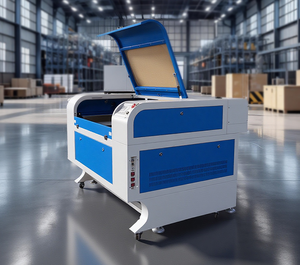
Explore our certified CO2 laser systems manufactured under stringent CE Safety Directives (2006/42/EC Machinery & 2014/30/EU EMC). Optimized for non-metallic processing, medical aesthetics, and high-speed industrial marking.
An authoritative procurement whitepaper on optical resonance, structural frame stress-relief, and thermal dynamics in modern industrial CO2 laser manufacturing.
Selecting an industrial CO2 laser system requires an in-depth analysis of the underlying laser cavity optics, beam quality ($TEM_{00}$ mode), power stability margin, and mechanical structural rigidity. As an OEM manufacturer, our production engineering adheres to rigid European Conformity standards, combining low-distortion zinc selenide (ZnSe) focusing optics with high-durability silicon/molybdenum reflection mirrors.
Every CE-marked CO2 machine produced in our facilities undergoes full compliance testing under the Electromagnetic Compatibility (EMC) Directive 2014/30/EU and Low Voltage Directive (LVD) 2014/35/EU. This prevents electromagnetic interference from high-voltage DC ignition transformers or RF power supplies from disrupting plant automation networks, CNC controllers, or external sensors.
Engineering Fact: Standard glass DC tube lasers require high-voltage pulses up to 25kV-30kV for gas ionization. Our CE-certified electrical architecture features double-shielded, grounded enclosures with isolated switching power supplies, reducing harmonic electrical noise to near-zero levels.
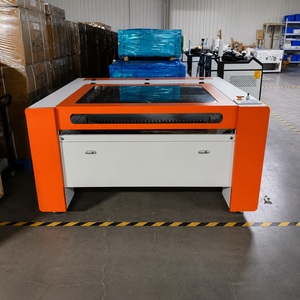
All machine frames undergo high-temperature thermal annealing to eliminate internal welding stress. This guarantees that linear guide alignment retains a ±0.01mm tolerance over years of intensive multi-shift operation.
Equipped with dual-channel smart chillers (S&A / Teyu equivalent) featuring digital fluid flow sensors, thermal over-limit kill switches, and signal integration directly into the main safety relay circuit.
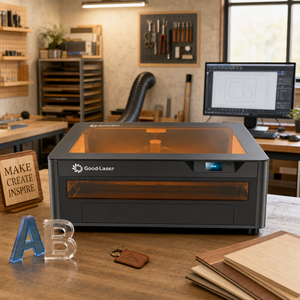
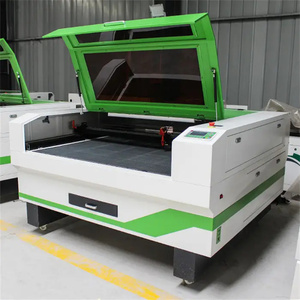
Custom-built fully enclosed desktop and industrial gantries utilize certified OD6+ polycarbonate viewing windows, fulfilling EN 60825-1 laser radiation containment specifications.
Understanding the molecular absorption coefficient of non-metallic polymers, organic textiles, and natural substrates under 10.6μm and 9.3μm infrared carbon dioxide laser wavelengths.
| Material Category | Specific Substrate | Absorption Rate @ 10.6μm | Recommended Power Class | Optimal Assist Gas & Pressure | Edge Quality & Thermal Effect |
|---|---|---|---|---|---|
| Cast Acrylic (PMMA) | Clear / Colored Plates | 92% - 95% | 80W - 150W Glass / RF | Dry Air @ 0.05 - 0.1 MPa | Flame-polished clear edge, zero kerf discoloration. |
| Hardwood & MDF | Birch, Oak, Density Fiberboard | 85% - 90% | 100W - 300W DC / RF | Clean Compressed Air @ 0.2 - 0.4 MPa | Sharp kerf, dark carbonized edge; clean surface with vector air jet. |
| Polyester & Leather | Synthetic Textiles, Genuine Hide | 88% - 94% | 60W - 100W Galvo / Plotter | Low-pressure Nitrogen or Air | Self-sealed melted edge prevents fraying; precise micro-perforation. |
| PET & Polycarbonate | Thin Packaging / Label Films | 90% - 96% | 30W - 50W RF Metal Tube | Dry Compressed Air @ 0.1 MPa | Ultra-thin HAZ (Heat-Affected Zone); crisp kiss-cutting without yellowing. |
| Anodized Aluminum | Coated Metal Signage | Surface Layer Removal | 30W - 100W Galvo | Ambient / Low Assist | High-contrast bright white marking by ablating organic dye layer. |
| Thin Carbon Steel | 0.5mm - 1.5mm Mild Steel | 12% (Requires Oxygen Boost) | 150W - 300W Mixed Laser | High-Purity $O_2$ @ 0.6 - 0.8 MPa | Burr-free metallic cut edge achievable with specialized capacitance head. |
How modern factories are adapting to next-generation RF tube technology, artificial vision alignment, and zero-emission factory standards to maintain sustainable global competitiveness.
Legacy manual positioning is rapidly being replaced by high-resolution CCD camera vision systems mounted directly on the laser carriage. AI algorithms instantly recognize printed registration marks, elastic distortion in printed textiles, and thermal shrinkage in heat-transfer films, automatically re-calculating vector toolpaths in milliseconds.
While glass water-cooled DC tubes remain cost-effective for entry-level operations, high-output industrial buyers are shifting toward metal ceramic RF (Radio Frequency) excited CO2 laser sources. RF sources feature pulse frequencies up to 250kHz, smaller focal spot size ($TEM_{00} \approx 1.1$), and maintenance-free operational lives exceeding 20,000 hours before gas refilling.
Global regulatory bodies require comprehensive risk assessments. Modern CO2 laser procurement mandates dual-channel safety relays, interlocking door switches, active smoke and flame detection, and multi-stage HEPA carbon filtration. Unenclosed Class-4 open beds are being systematically phased out in modern European and North American facilities.
Why procurement leads and global industrial buyers partner directly with our specialized laser manufacturing plant for custom equipment engineering.
We are a dedicated machine builder, not a trading company. Every machine platform is engineered, assembled, wired, and commissioned within our controlled production facility. Our engineering team evaluates your specific material processing challenges as a complete manufacturing cell—balancing loading automation, laser cavity tuning, fume evacuation, and downstream part marking.
Consult directly with our optical application engineers to configure workbed dimensions, power outputs, and optional vision or rotary accessories tailored to your operational specifications.
Expert answers to the most critical technical and regulatory questions asked by factory engineers and supply chain procurement managers.