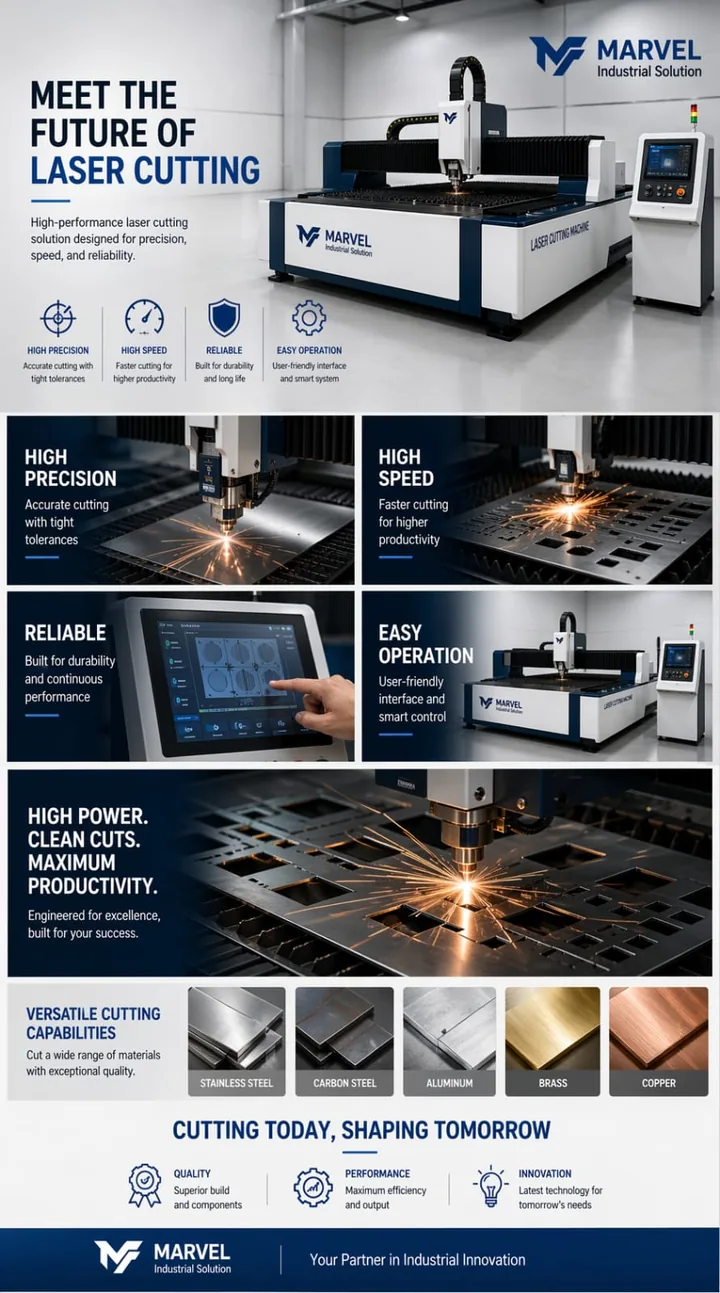
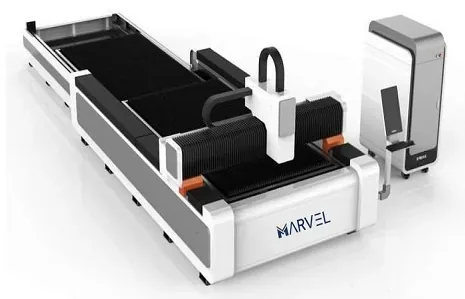
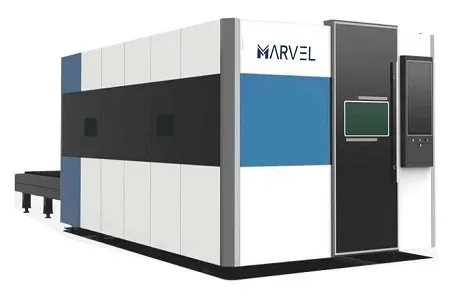
Exchange Table Fiber Laser Cutting Machine
The industry benchmark for high-volume elevator door skin and cab panel fabrication. Features continuous dual-pallet swapping to maximize spindle beam time.
Engineered specifically for elevator car panels, landing doors, structural guide rail brackets, and mirror stainless steel door skins. Delivering zero-scratch material handling, ±0.03 mm positioning accuracy, and automated production efficiency.
In modern elevator and lift manufacturing, speed alone does not guarantee profitability. Elevator doors, car side panels, ceilings, and landing frames demand impeccable surface aesthetics, exact bending allowances, and zero thermal deformation. Operating an industrial Elevator Manufacturing Laser Cutting Machine requires custom machine dynamics: high acceleration, specialized assist gas mixing, linear encoder feedback, and anti-scratch bed configurations to prevent surface damage on film-laminated hairline or mirror-finish stainless steel.
Marvel Industrial Solution manufactures industrial-grade CNC fiber laser cutting systems, tube cutting platforms, and integrated robotic cells from our specialized manufacturing facility in Ahmedabad, Gujarat, India. By stress-relieving every heavy-duty welded gantry frame in annealing furnaces and precision-milling mounting surfaces in a single setup, our laser machines maintain high dynamic repeatability even under continuous 24/7 operating schedules.
Elevator fabrication requires a delicate balance between fine architectural sheet metal work and heavy mechanical structural engineering. Below is an engineering overview of how specialized laser parameters meet elevator manufacturing standards.
Elevator door panels and car enclosure walls rely on 0.8mm to 1.5mm stainless steel (AISI 304/316) featuring decorative finishes such as Brushed, Hairline, Mirror, Etched, or Ti-Gold PVD coatings. Traditional punching presses cause oil contamination, edge burrs, and micro-warping across wide panel expanses.
Elevators require rugged structural integrity for counterweight frames, guide rail bracketry, cabin sling assemblies, and safety gear mounts. These components typically utilize 6mm to 20mm structural carbon steel (S235/S355 or Q235/Q355 grades).
Explore our targeted equipment lineup designed to optimize every stage of elevator cab, door frame, structural guide, and tube support fabrication.
The industry benchmark for high-volume elevator door skin and cab panel fabrication. Features continuous dual-pallet swapping to maximize spindle beam time.
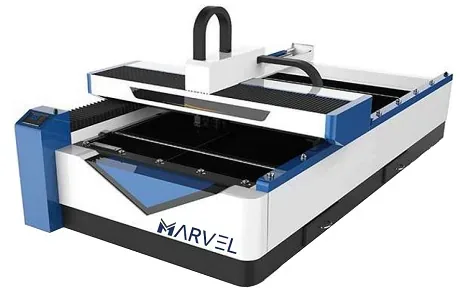
Compact, highly rigid sheet cutter for customized elevator interior panels, ceiling light grilles, and specialized floor plates requiring flexible batch production.
Engineered for extra-long elevator guide rail brackets, counterweight frames, and structural hoistway beams up to 12 meters long without repositioning.
Ideal for elevator stainless steel handrails, tubular car frames, and structural shaft pipe supports. Performs copes, bevels, and slot cutouts seamlessly.
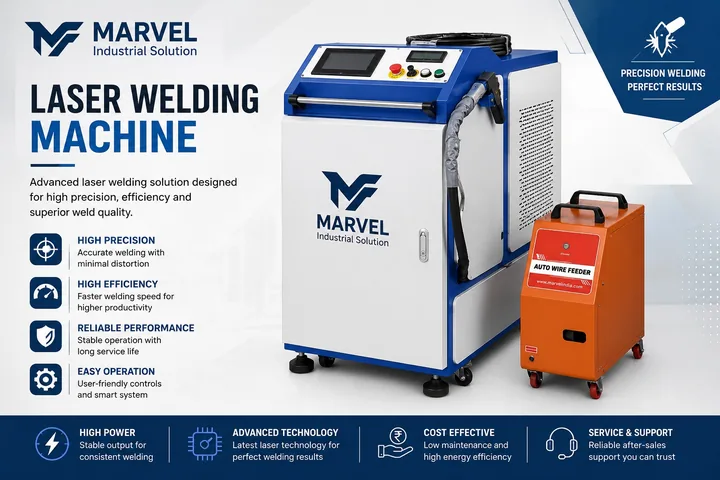
Replaces traditional TIG welding for attaching door panel stiffeners and cabin reinforcing ribs. Yields minimal heat distortion and zero surface show-through.
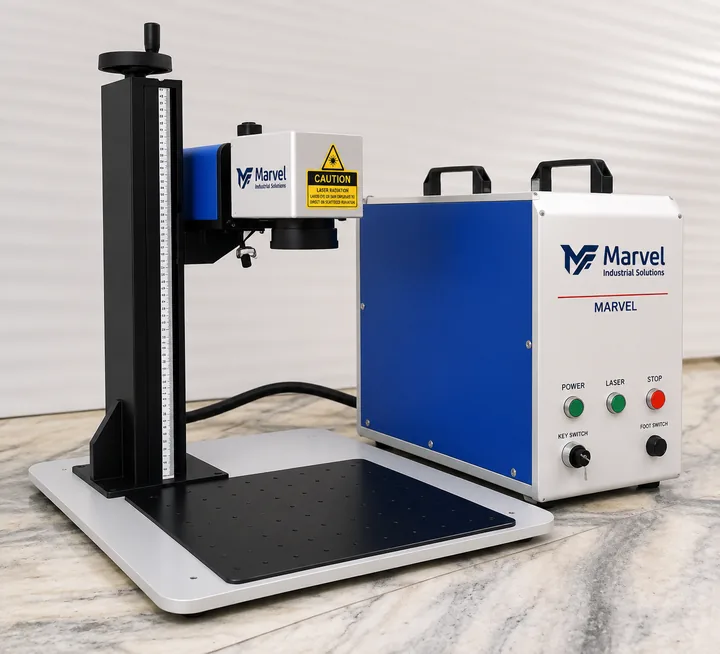
Applies high-resolution permanent QR codes, batch serial numbers, and safety warning diagrams directly onto stainless COP/LOP plates and safety components.
Choosing the correct laser power and assist gas configuration directly impacts part edge quality, production speed, and operational cost per sheet in elevator plants.
| Elevator Component | Typical Material & Thickness | Recommended Laser Power | Assist Gas Choice | Key Edge & Quality Objective |
|---|---|---|---|---|
| Elevator Car Door Skins | 0.8 mm - 1.5 mm Stainless Steel (304/316) | 1.5 kW - 3.0 kW Fiber | High-Pressure Nitrogen (N₂) | 100% burr-free edge, zero film burning, mirror surface protection |
| Landing Door Frames | 1.2 mm - 2.0 mm Galvanized Sheet Steel | 2.0 kW - 4.0 kW Fiber | Nitrogen or Clean Air | No zinc flaking, smooth bend lines, fast cutting feed rates |
| Car Ceiling & Floor Plates | 1.5 mm - 3.0 mm Stainless / Carbon Steel | 3.0 kW - 6.0 kW Fiber | Nitrogen (N₂) | Intricate pattern cutting, zero thermal warpage across large sheets |
| Guide Rail Brackets | 6.0 mm - 12.0 mm Carbon Steel (Q235/S235) | 4.0 kW - 12.0 kW Fiber | Oxygen (O₂) or High-Pressure Air | Clean vertical edge, accurate bolt hole roundness (±0.05 mm) |
| Hoistway Structural Beams | 14.0 mm - 25.0 mm Mild Steel Plate | 12.0 kW - 30.0 kW Fiber | Oxygen (O₂) Bright Cut | High separation speed, low taper, dross-free bottom edge |
| Handrails & Cab Tubing | 1.5 mm - 3.0 mm Stainless Steel Tube | 1.5 kW - 3.0 kW Tube Laser | Nitrogen (N₂) | Tight joint fit-up for seamless assembly and hand polishing |
Note: Processing speed and assist gas consumption vary based on sheet grade, film density, and nozzle geometry. Contact our technical team for custom cycle-time calculations.
Global elevator OEMs are modernizing their manufacturing facilities to meet smart building standards, strict fire safety codes (such as EN 81-20/50 and ASME A17.1), and rapid urbanization demands. Here are the core technological trends shaping future machinery purchases.
Elevator door panels are long, standardized parts. Transitioning from flat sheet cutting to automated coil-fed fiber laser cutting lines eliminates sheet shearing steps, lowers scrap rates by up to 15%, and enables continuous lights-out blanking directly from steel coils.
High-power fiber lasers cut faster than operators can unload. Future elevator plants integrate automated multi-tower sheet material storage with vacuum suction pick-and-place gantry robots to sort cut door skins and stiffeners directly onto bending pallets.
With fiber power escalating to 20kW-30kW, thick structural brackets (16mm-25mm) that previously required slow oxygen cutting can now be cut using high-pressure nitrogen. This delivers oxide-free cut surfaces that need no secondary grinding prior to paint or powder coating.
Purchasing an Elevator Manufacturing Laser Cutting Machine is a long-term capital investment. At Marvel Industrial Solution, our engineering focus goes beyond assembling standard components—we design full end-to-end production automation tailored to sheet metal doors, frames, and structural lift elements.
Expert technical answers to questions global procurement directors and fabrication leads ask when choosing fiber laser cutting equipment for elevator production.
Preventing surface scratches on PVC-coated mirror or hairline stainless steel is critical in elevator door manufacturing. Our machines incorporate three dedicated design enhancements:
For most standard elevator door skin and cabin wall production lines (processing 0.8mm to 2.0mm stainless steel and galvanized sheets), a 3kW to 6kW fiber laser cutting machine offers the optimal throughput-to-cost ratio. If your factory also fabricates heavy structural guide rail brackets, counterweight frames, and elevator pit structural plates exceeding 12mm thickness, we recommend a 12kW to 20kW exchange table model to maintain fast cut feeds on thick plate.
Yes. Fiber lasers operate at a 1064nm wavelength which is efficiently absorbed by coated, etched, and textured metal surfaces. Combined with non-contact capacitive height sensing, the laser cutting head follows 3D surface contours smoothly—maintaining exact standoff distance even on slightly bowed embossed or wave-pattern elevator panels.
An Exchange Table (Dual Pallet Shuttle) Fiber Laser Cutting Machine allows the operator to load a new sheet and remove cut parts on one table while the laser continues cutting inside the enclosure on the other bed. For high-volume elevator panel runs, this eliminates up to 40 seconds of idle loading time per sheet, increasing shift productivity by 25% to 35% compared to a single-table machine.
Every export machine from Marvel Industrial Solution includes comprehensive global support: seaworthy wooden crate packaging, complete electrical schematics, step-by-step foundation drawings, and pre-loaded nesting parameters. We dispatch experienced commissioning engineers for on-site setup and operator training. Furthermore, remote IP camera diagnostics and quick-ship spare parts kits ensure your production line stays operational without prolonged downtime.
Yes. We offer dual-use sheet & tube laser cutting machines as well as dedicated 3D CNC Laser Tube Cutting Machines. These systems clamp round, square, or rectangular tubing to cut handrail ends, mounting slot holes, and interlocking frame copes accurately in one setup, replacing manual drilling, sawing, and grinding.
Send us your DXF part drawings, required sheet thickness, and target monthly output. Our laser application engineers will perform nesting calculations, recommend the ideal power package, and provide a detailed quotation for your elevator factory.
Quick reference index covering technologies, materials, and processes supported by our OEM laser machinery range.