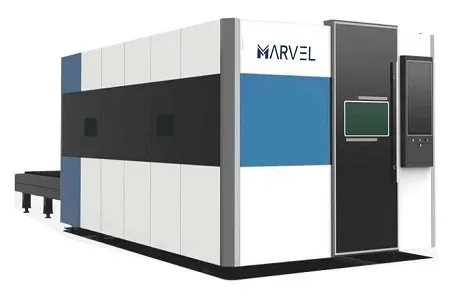
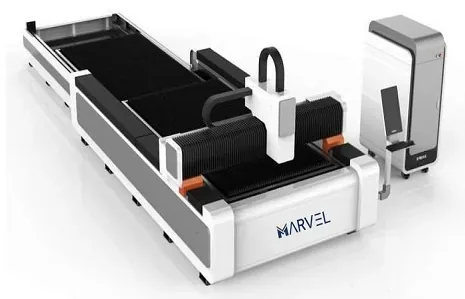
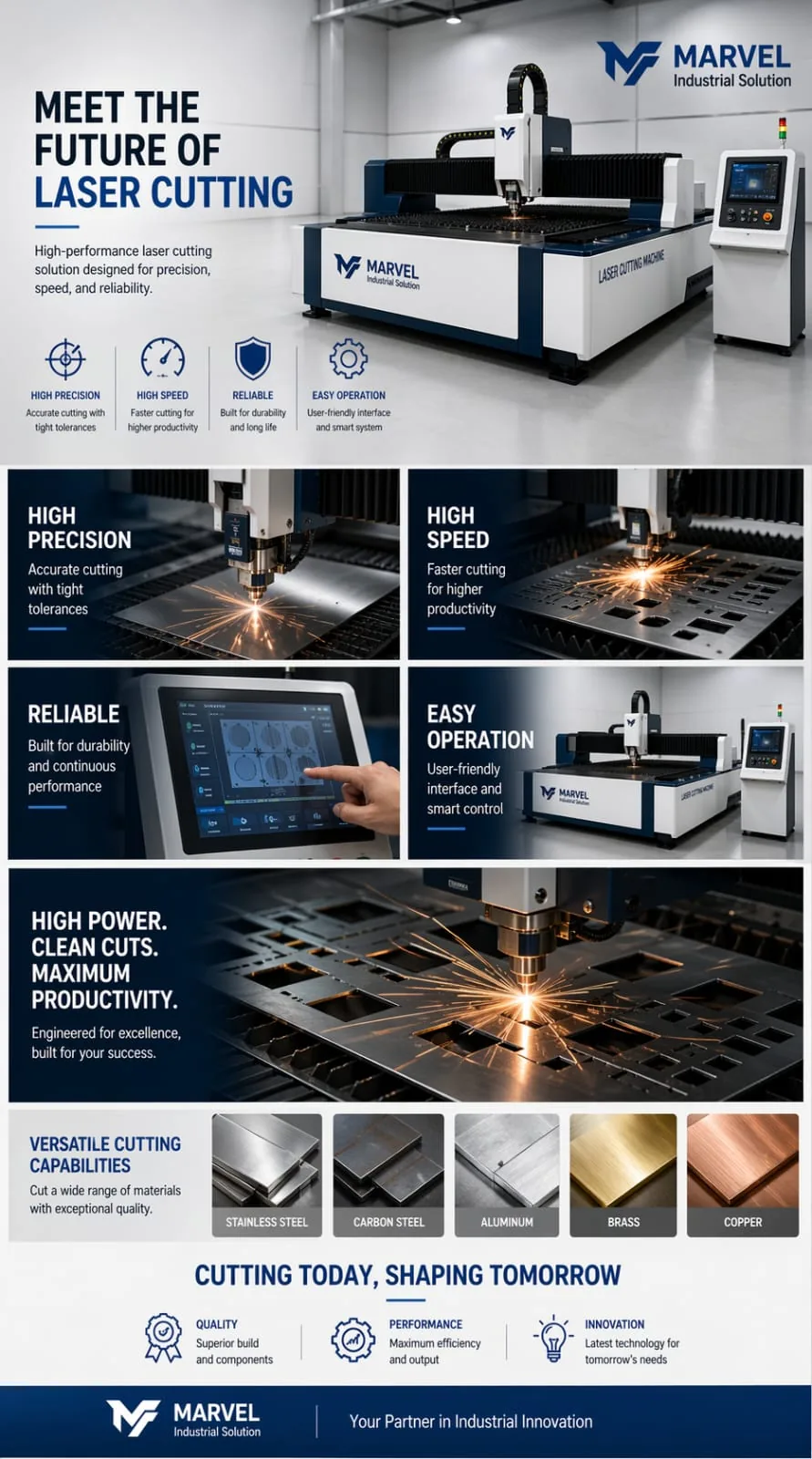
Engineered specifically for structural steel fabricators, shipbuilding yards, heavy equipment manufacturers, and pressure vessel OEMs processing 16mm to 80mm medium-thick to extra-thick steel plates with absolute thermal stability and micro-scale edge precision.
Why Global Procurement Officers Shortlist Heavy Engineering Plate Cutting Machines by Marvel
In modern heavy machinery manufacturing, yellow-goods fabrication, wind tower production, and marine structural engineering, traditional cutting technologies such as oxy-fuel flame and high-definition plasma are rapidly facing economic and operational obsolescence. The emergence of ultra-high-power fiber laser generators (12kW, 15kW, 20kW, 30kW, and up to 60kW) has fundamentally redefined the physics and economics of thick metal plate blanking.
A true Heavy Engineering Plate Cutting Machine is not simply a standard sheet laser cutter scaled up in size. It represents a ground-up mechanical engineering platform designed to absorb multi-ton static loading, dissipate immense localized thermal radiation, maintain structural parallelism over 12 to 24-meter bed lengths, and deliver high-speed, zero-dross cuts with tight taper control.
At Marvel Industrial Solution (based in Ahmedabad, Gujarat, India), we design, build, test, and commission heavy-duty CNC fiber laser cutting systems from raw steel plate to finished machine cell. Our cross-disciplinary engineering teams combine optical physics, motion dynamics, and customized special-purpose machine (SPM) automation to solve real shop-floor bottlenecks for global industrial buyers.
Stress-Relieved Mortise-and-Tenon Frames: Heavy plate structural steel beds subjected to 600°C thermal annealing to ensure zero dynamic distortion after years of multi-ton loading.
Advanced Thermal Isolation Architecture: Water-cooled bed structures and independent matrix dust extraction zone gates prevent bed frame heat deformation during long-shift continuous cutting.
Integrated 5-Axis Beveling Capability: Eliminates costly secondary bevel milling by performing V, X, Y, and K-shaped weld preps directly during the primary laser cutting pass.
Heavy Engineering Plate Cutting Performance & Gas Dynamics Matrix
This technical empirical data table provides procurement directors and factory managers with direct performance benchmarks comparing laser power classes against material thicknesses, assist gas selection, cutting speeds, and kerf edge quality metrics.
Note: Data reflects production-grade continuous operation on structural carbon steel (Q235B/Q355B/S355JR) and stainless steel (304/316L) under optimized focal length and gas pressure settings. Maximum separation thickness exceeds production ratings.
Laser Power Class
Carbon Steel (O₂ Piercing/Cut)
Carbon Steel (High-Press Air/N₂)
Stainless Steel (N₂ Bright Cut)
Avg. Production Speed (20mm CS)
Kerf Edge Roughness (Ra)
12 kW Fiber Laser
Up to 35 mm
Up to 20 mm
Up to 25 mm
1.8 - 2.4 m/min
Ra 6.3 - 12.5 μm
15 kW Fiber Laser
Up to 45 mm
Up to 25 mm
Up to 30 mm
2.6 - 3.2 m/min
Ra 6.3 - 9.0 μm
20 kW Fiber Laser
Up to 55 mm
Up to 32 mm
Up to 40 mm
3.8 - 4.5 m/min
Ra 3.2 - 6.3 μm
30 kW Fiber Laser
Up to 70 mm
Up to 45 mm
Up to 55 mm
5.5 - 6.8 m/min
Ra 1.6 - 4.5 μm
40kW - 60kW (Custom)
Up to 100 mm+
Up to 60 mm
Up to 80 mm
8.0 - 11.0 m/min
Ra 1.6 - 3.2 μm
Technical Engineering Insight: When moving from 12kW to 30kW fiber lasers, assist gas dynamics shift dramatically. While oxygen cutting relies on an exothermic reaction to melt carbon steel (limiting speed but preserving laser energy), high-pressure compressed air and nitrogen cutting at 20kW+ use pure kinetic force to purge molten metal. This delivers a 300% to 500% increase in cutting velocity on medium-thick plates (12mm–25mm) while completely eliminating oxide scale formation prior to welding.
Under the Hood
Structural Architecture of a Heavy-Duty CNC Plate Cutting Platform
Machine accuracy in heavy plate laser cutting depends on mechanical frame rigidity and vibration damping far more than light-sheet machinery. Here is how Marvel engineers longevity into heavy-duty gantry systems.
Mortise-Tenon Structural Machine Bed
Our heavy engineering plate cutting machine frames are fabricated from thick-section carbon structural steel plates using interlocking mortise-and-tenon joints. This architectural design locks all structural members mechanically prior to robotic arc welding, ensuring superior frame stiffness and zero joint shear under dynamic braking forces.
600°C Stress Relief Heat Treatment
To eliminate internal residual stresses caused by rolling and welding, every bed structure undergoes a 600°C high-temperature annealing furnace cycle followed by controlled 24-hour slow cooling. This prevents geometric deformation over decades of constant shop floor vibration and thermal loading.
Thermodynamic & Zoned Fume Isolation
Cutting thick steel plates generates massive heat and concentrated toxic metal fumes. Marvel machines incorporate isolated water-cooled slate beds detached from the main guide rails, combined with pneumatic multi-zone exhaust dampers that open only directly underneath the active cutting head.
Featured Heavy Engineering Plate Cutting Machine Platforms
Select the ideal machine platform based on your production envelope, material handling configuration, and target shift output.
Ultra-Large Format Heavy Single Bed Machine
Designed for heavy structural fabricators and equipment manufacturers requiring bed lengths up to 24 meters and power sources from 12kW to 30kW. Features open floor loading for heavy overhead crane operations.
12kW - 30kW+Bed Length: 6m - 24mPlate Thickness: Up to 80mm
High-yield dual pallet shuttle platform equipped with heavy-duty hydraulic lifting chains. Enables continuous loading of multi-ton steel plates on Pallet B while the laser actively cuts on Pallet A.
Integrated infinite rotary 3D bevel head capable of cutting precise V, X, Y, and K bevel angles (±45°) directly on thick carbon steel plates. Eliminates post-cut edge preparation milling.
Future Procurement & Technology Trends in Heavy Engineering Plate Cutting
As industrial automation accelerates globally, buying decisions for heavy metal processing equipment are shifting toward four critical technological benchmarks.
1. Shift from Oxygen to High-Pressure Air/Mix Gas Blanking
Historically, thick carbon steel cutting relied almost exclusively on low-pressure oxygen oxidation. Modern 20kW to 30kW fiber lasers have revolutionized this approach. Factory buyers are increasingly adopting ultra-high-pressure air and nitrogen-oxygen mixing units. This transition cuts gas costs by up to 60-70% while dramatically boosting cutting speed on 14mm to 30mm structural plates.
Thick plate piercing is the highest risk event for optical contamination and head collisions. Next-generation heavy plate cutters incorporate optical real-time sensors (photodiodes) directly inside the cutting head. The CNC continuously monitors plasma flash and back-reflection, dynamically adjusting laser peak power and frequency to achieve zero-burst, fast piercing without blowing out surrounding metal.
3. Single-Pass 3D Beveling Replacing Secondary CNC Milling
In structural steel and pressure vessel production, welding standards demand strict edge bevel profiles. Procurement teams are moving away from traditional setup-intensive flame bevelers and mechanical edge planers. Installing a 5-axis 3D laser bevel head on a Heavy Engineering Plate Cutting Machine completes shape contouring and edge chamfering in one continuous operation, saving hundreds of labor hours per month.
4. Automated Heavy Material Handling & Magnetic Gantries
A 30kW laser cutting machine can process a 20mm 6m x 2m steel plate in minutes, making manual loading with standard shop cranes a severe production bottleneck. Heavy engineering procurement now prioritizes integrated magnetic or vacuum gantry systems and automated sorting arms capable of handling 500kg to 5-ton steel components seamlessly.
Total Cost of Ownership (TCO) Analysis: Fiber Laser vs. High-Definition Plasma
A rigorous economic comparison for financial decision-makers evaluating multi-year machinery ROI.
Key Operational Cost Components
When operating a Heavy Engineering Plate Cutting Machine, direct costs fall into four primary categories: Electrical Energy, Assist Gas Consumption, Optical Consumables, and Secondary Labor.
Energy Efficiency: Fiber lasers achieve wall-plug efficiency above 40%, compared to less than 15% for plasma units, dramatically lowering electricity cost per ton of cut steel.
Zero Secondary Grinding: Fiber laser cut edges are virtually dross-free with perpendicularities within ISO 9013 Class 2/3 tolerances, eliminating manual grinding teams.
Reduced Consumable Wear: High-power laser protective windows and copper nozzles operate for hundreds of hours under clean gas purging, avoiding frequent plasma torch tip burnouts.
Engineering Rigor, In-House Manufacturing & Global Support
Marvel Industrial Solution operates as a true machinery manufacturer, not a trading enterprise. Located in the industrial heartland of Ahmedabad, Gujarat, India, our engineering complex manages frame machining, stress relief, optical assembly, electrical wiring, and software testing under one roof.
Because our core product lines span fiber laser cutters, tube cutters, laser welders, laser markers, and robotic automation (gantry and press-transfer robots), we evaluate your manufacturing floor as a single unified ecosystem. We integrate upstream plate handling and downstream weld preparation directly into our CNC control schemes.
Sample-First Verification: Send us your DXF drawings or part samples. We cut your actual steel thickness, document kerf roughness and perpendicularity, and return test video and metallographic data before order confirmation.
Request a Tailored Heavy Plate Cutting Proposal & Nesting Report
Send our senior laser application engineers your target plate dimensions, steel grades, monthly tonnage targets, and DXF drawings. We will compile a comprehensive machine sizing proposal, power selection audit, and return test-cut samples.
Heavy Engineering Plate Cutting Machine Procurement FAQs
Direct technical answers to questions most frequently asked by global procurement officers, plant engineering heads, and fabrication directors.
Selecting laser power for a Heavy Engineering Plate Cutting Machine depends on your thickest regular production material rather than occasional maximums. For carbon steel up to 25mm, a 12kW fiber laser delivers rapid cutting. When processing 30mm to 50mm carbon steel or heavy stainless steel, a 20kW or 30kW laser power source is recommended to maintain high cutting velocity, narrow kerf width, and complete verticality with zero bottom dross. For plates exceeding 60mm, custom 40kW+ platforms are deployed.
Thermal management is critical when cutting thick steel plates due to localized heat concentration. Marvel’s heavy plate cutting platforms address this through a four-tier design: (1) Mortise-and-tenon welded steel frames stress-relieved at 600°C, (2) Water-cooled bed slats and thermal isolation support structures, (3) Zoned pneumatic dust extraction dampers that pull heat downward, and (4) Intelligent CNC pathing routines (such as micro-joints, lead-in cooling pauses, and heat-dispersed leapfrog cutting sequencing).
High-power fiber laser systems outperform plasma and oxy-fuel cutting in four operational dimensions: Speed (3x to 5x faster processing on 12mm-30mm plates), Quality (edge perpendicularity <0.5° with a significantly reduced Heat-Affected Zone), Cost Efficiency (elimination of secondary edge grinding or bevel milling), and Precision (positioning tolerances of ±0.03mm/m compared to ±1.0mm in plasma).
Yes. Our heavy engineering plate cutters can be equipped with an advanced 5-axis 3D rotary beveling cutting head. This setup enables automated cutting of V, X, Y, and K-shaped bevel angles (ranging from ±15° to ±45°) directly during the main profiling pass. This completely removes the requirement for offline edge planing, bevel milling, or manual grinding prior to structural welding.
A 30kW heavy plate cutting machine requires a dedicated reinforced concrete foundation bed (minimum 300mm to 500mm depth depending on soil bearing capacity) with perimeter isolation joints to isolate external crane vibration. Electrically, a 30kW system with dual-circuit industrial chiller, high-capacity dust collector, and drive amplifiers has a total connected electrical load of approximately 120kW to 150kW (3-Phase 415V/480V, 50/60Hz).
Oxygen (O₂) is traditionally used for thick carbon steel because the exothermic reaction assists the laser in melting the metal at low gas pressure (0.5-1.5 bar). However, on 20kW+ laser systems, high-pressure compressed air or nitrogen (16-25 bar) purging is increasingly favored for plates up to 25mm-30mm. Air/N₂ cutting dramatically increases cutting speed (up to 300% faster) and yields an oxide-free edge, though operating gas pressure and compressor power requirements are higher.
High-power fiber laser optics (12kW-30kW+) are sensitive to dust and thermal lensing. Marvel integrates heavy-duty cutting heads (Precitec/Boci) featuring sealed optical chambers, dual protective window drawers, automated focus positioning, dynamic water cooling, and real-time pressure monitoring. Every machine undergoes 48-hour continuous test cutting and thermal stability logging before leaving our plant.
Yes. Marvel Industrial Solution exports heavy-duty laser machinery globally. Every export order includes seaworthy wooden/frame packaging, detailed foundation drawings, electrical schematics, on-site commissioning by experienced field engineers, nesting software operator training, and structured 1st-year/2nd-year preventive maintenance spares kits.