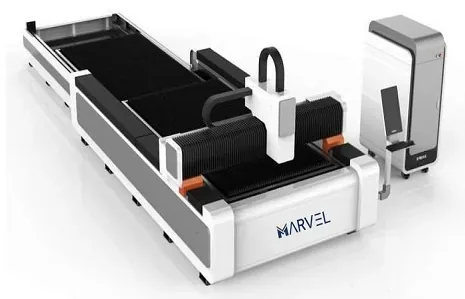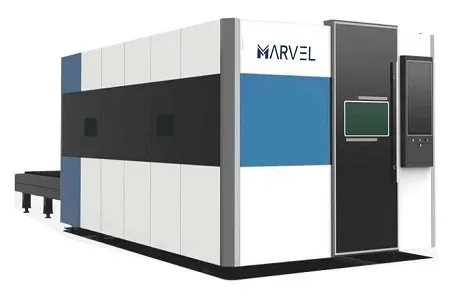
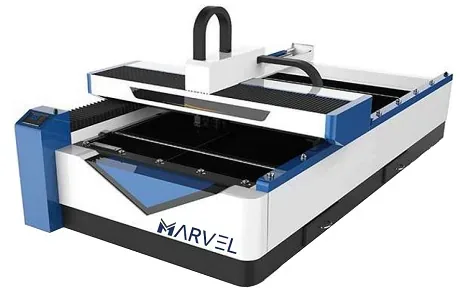
Single Table Sheet Metal Laser Machine
An entry-to-mid level workhorse for job shops, prototype labs, and medium-volume fabricators needing precision cutting across carbon steel, stainless steel, and aluminum.
A comprehensive industrial guide for global procurement teams, plant engineers, and job shop executives evaluating 1.5kW to 30kW fiber laser machines, dual-pallet shuttle tables, tube cutters, and custom robotic automation cell integration.
In modern industrial manufacturing, investing in a high-performance sheet metal fabrication laser machine requires an understanding of laser optics, kinetic machine bed dynamics, and thermodynamics. Unlike light-duty CO2 cutting systems of the past decade, modern solid-state fiber laser machines utilize a 1.064-micron wavelength. This beam wavelength is absorbed by metals at rates 300% to 500% higher than traditional gas lasers, dramatically boosting energy efficiency and line speed on reflective non-ferrous alloys like aluminum, brass, and copper.
At Marvel Industrial Solution, located in Ahmedabad, Gujarat, India, our machine engineering revolves around eliminating structural vibration and thermal expansion drift during high-g accelerations (up to 1.5G). We achieve long-term precision through heavy-duty steel plate welding and high-temperature stress-relief annealing furnaces running at 600°C–650°C, followed by 24-hour controlled cooling and vibration stress relief (VSR).
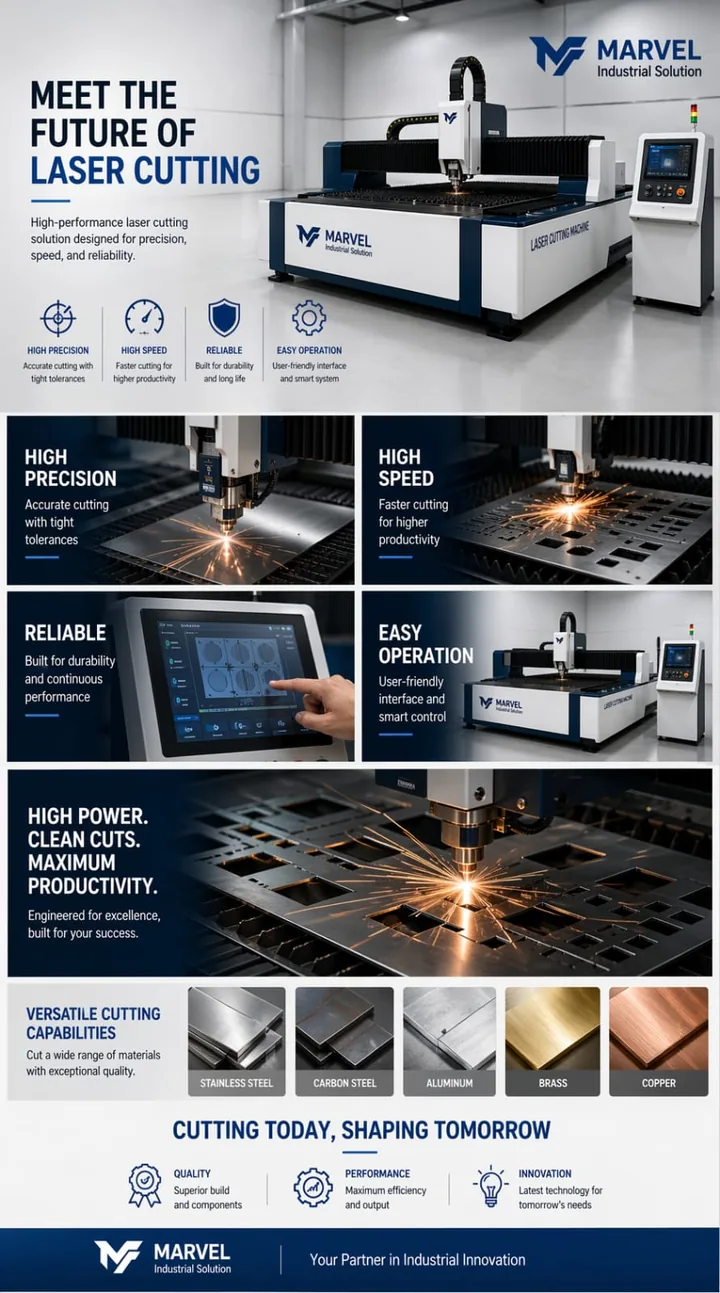
Explore our lineup of industrial fiber laser cutting machines, tube profiling systems, handheld laser welders, and automated special purpose machines built to streamline production floors worldwide.

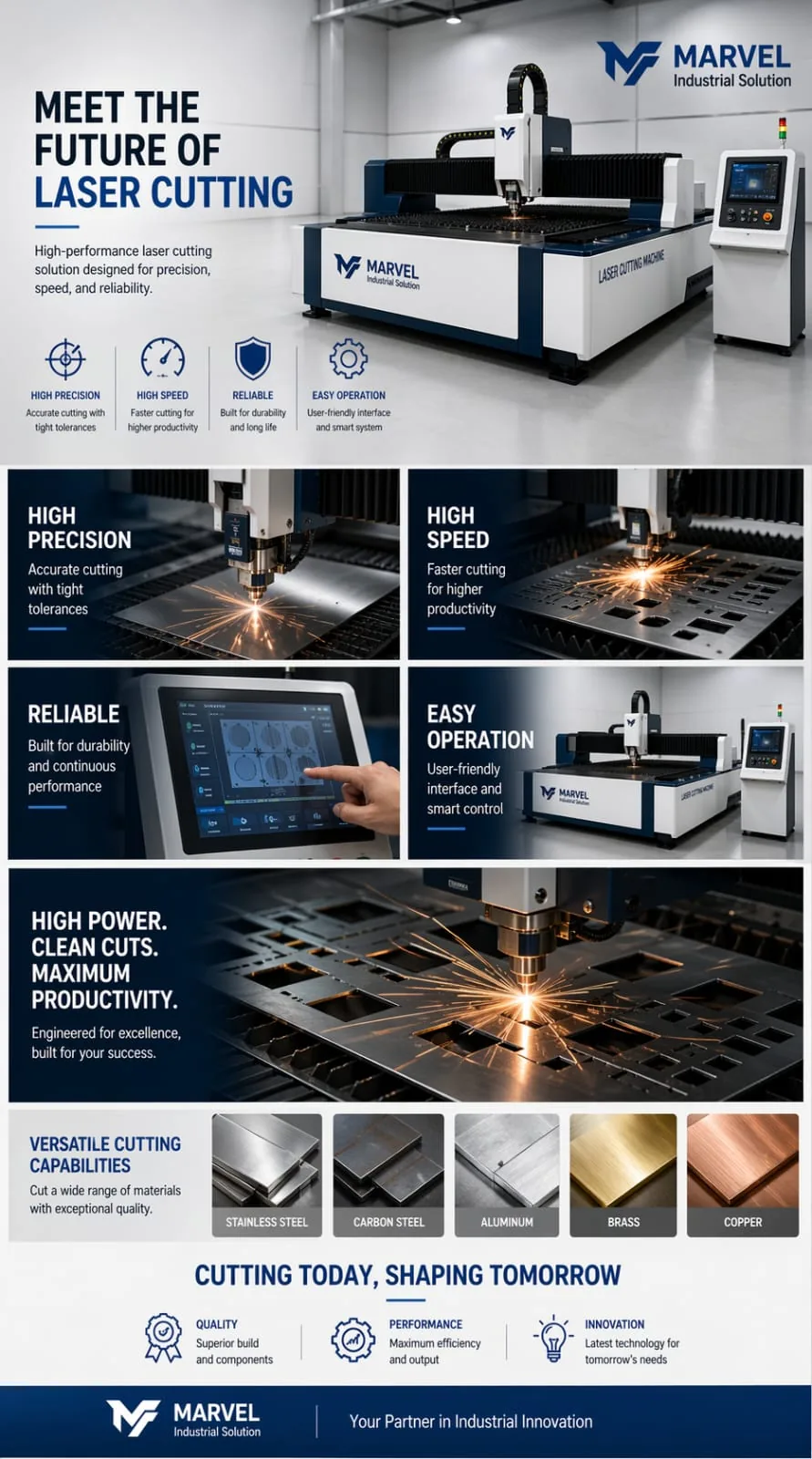
An entry-to-mid level workhorse for job shops, prototype labs, and medium-volume fabricators needing precision cutting across carbon steel, stainless steel, and aluminum.

High-duty cycle shuttle system featuring an automated 10 to 15-second pallet exchange mechanism. Maximizes spindle-on time by allowing simultaneous cutting and material offloading.

Designed for structural steel fabricators, yellow goods manufacturers, and shipyards processing thick carbon steel plate up to 40mm and stainless up to 35mm.

Integrated chuck-driven laser system for processing round pipes, square tubing, rectangular channels, and open profiles with complex copes, bevels, and perforations.

Continuous coil-fed blanking line integrated with uncoiler, leveler, and laser cutting head. Ideal for high-volume automotive panels and HVAC ducting with near-zero scrap.

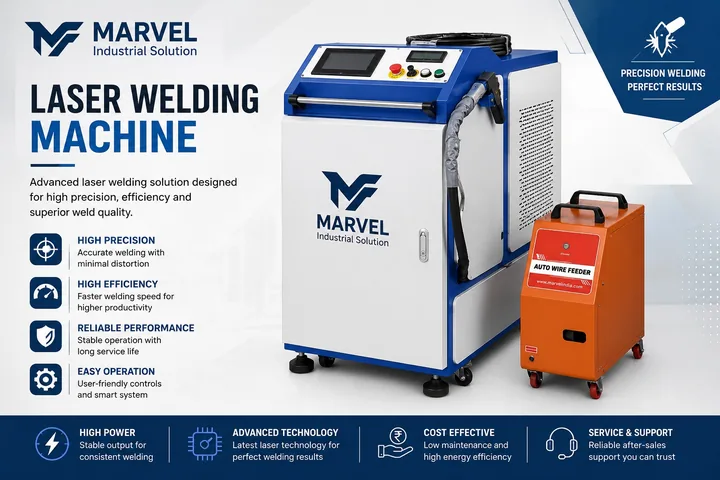
Portable wobble-head laser welder replacing TIG/MIG welding. Delivers 4x to 10x faster welding speeds with minimal heat-affected zone (HAZ) and virtually no secondary grinding.

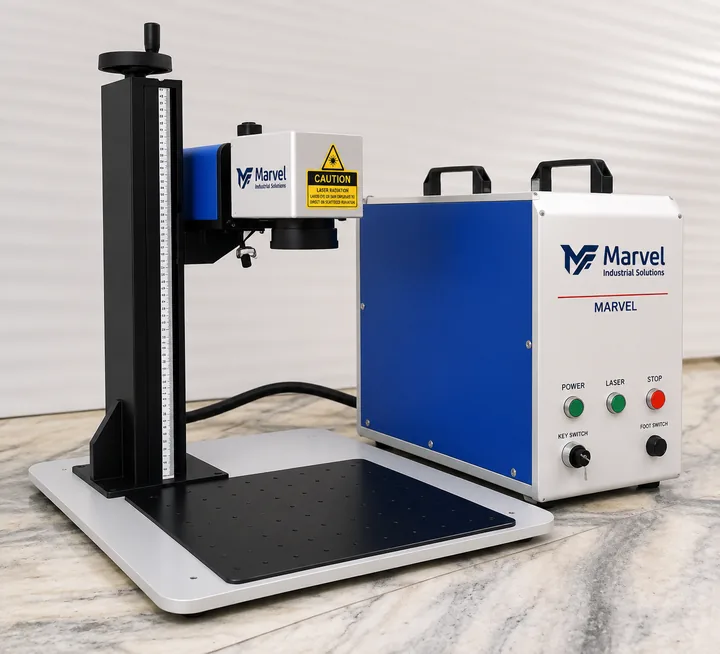
High-speed laser marking for serial numbers, Data Matrix 2D codes, logos, and QR codes directly on cut sheet metal parts and automotive stampings.

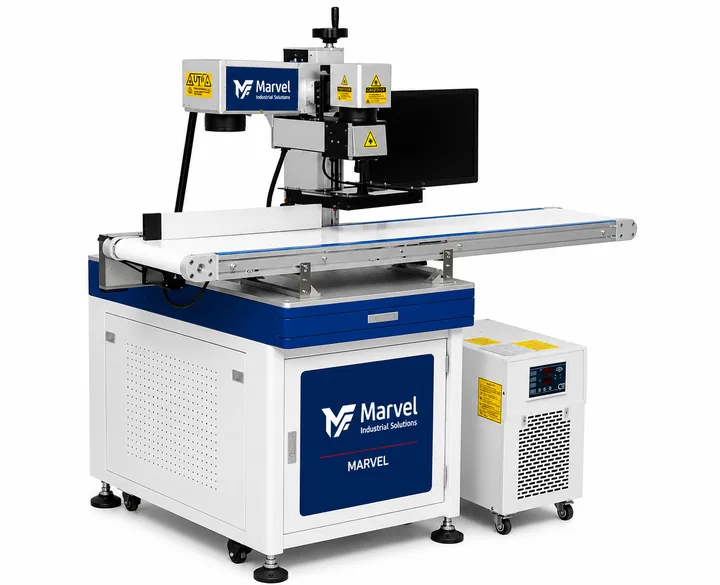
Camera-assisted dynamic marking system that automatically identifies part orientation and positioning on conveyor trays, eliminating expensive mechanical indexing jigs.

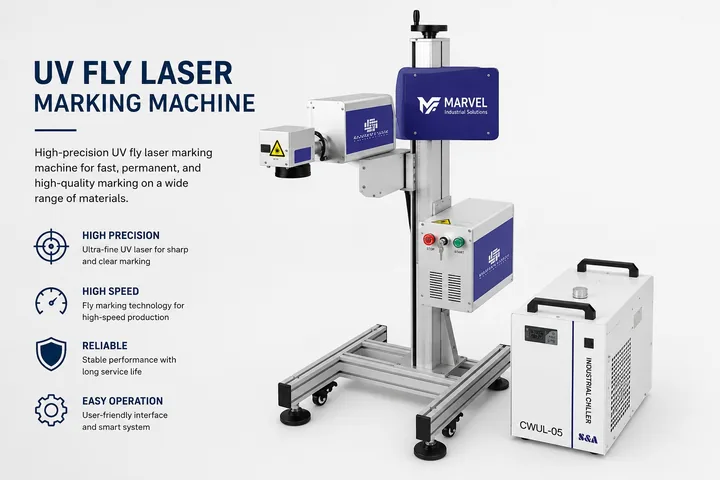
355nm ultraviolet cold laser marking source designed for high-speed continuous line coding of polymers, coated metal sheets, and sensitive electrical enclosures.
Real-world production data used by Marvel engineers to select power classes, assist gases, and feed rates based on material types and quality edge requirements.
| Laser Wattage | Material Type | Thickness (mm) | Assist Gas | Cutting Speed (m/min) | Edge Finish Quality |
|---|---|---|---|---|---|
| 1.5 kW | Carbon Steel (S235JR) | 1.0 mm - 6.0 mm | Oxygen ($O_2$) / Air | 1.8 - 18.0 m/min | Clean, smooth dross-free edge |
| 1.5 kW | Stainless Steel (AISI 304) | 0.8 mm - 3.0 mm | Nitrogen ($N_2$) | 2.5 - 22.0 m/min | Oxide-free silver bright edge |
| 3.0 kW | Carbon Steel (S235JR) | 1.0 mm - 16.0 mm | Oxygen ($O_2$) | 0.8 - 25.0 m/min | Square kerf, minor oxide layer |
| 3.0 kW | Aluminum Alloy (6061-T6) | 1.0 mm - 8.0 mm | Nitrogen ($N_2$) | 1.2 - 20.0 m/min | Burr-free, smooth surface finish |
| 6.0 kW | Carbon Steel (S235JR) | 1.0 mm - 22.0 mm | Oxygen / Compressed Air | 0.6 - 35.0 m/min | High-speed production cut |
| 6.0 kW | Stainless Steel (AISI 316L) | 1.0 mm - 14.0 mm | High-Pressure $N_2$ | 1.0 - 30.0 m/min | Bright mirror finish edge |
| 12.0 kW | Carbon Steel (S235JR) | 2.0 mm - 30.0 mm | Air / $O_2$ / Air Mix | 0.5 - 55.0 m/min | Ultra-fast thin gauge, heavy plate capable |
| 20.0kW - 30.0 kW | Heavy Steel Plate / Armor | 3.0 mm - 40.0 mm | Air / $N_2$ Bright Cut | 0.4 - 70.0 m/min | Structural welding ready without edge prep |
Note: Cutting speeds are subject to plate surface quality, assist gas purity (Nitrogen ≥ 99.999%), nozzle orifice geometry, and optical focus settings. For custom alloy trials, contact our application laboratory.
Insights into how tier-1 automotive fabricators, industrial OEMs, and contract metal shops are optimizing their factory floors from 2026 to 2030.
High-wattage fiber laser sources are replacing traditional plasma and oxy-fuel flame cutting for plates above 20mm. High-pressure air cutting on 20kW+ machines reduces gas costs by up to 70% while quadrupling linear cutting speed on carbon steel.
Standalone laser cutting is transitioning to automated tower storage and retrieval systems (ASRS). Automated suction sheet loading arms and part-sorting robots enable 24/7 unassisted "lights-out" sheet metal blanking.
Modern laser cutting heads integrate acoustic emissions sensors, thermal nozzle monitoring, and real-time optical plasma detection. AI algorithms dynamically adjust feed rate and gas pressure to prevent cut interruption or dross formation.
Marvel Industrial Solution operates a state-of-the-art machinery manufacturing plant in Gopal Charan Industrial Hub, Ahmedabad, Gujarat. We engineer, assemble, align, and test sheet metal fabrication laser machines, laser tube cutters, handheld laser welders, auto metal polishing SPM lines, and press automation robots under one roof.
Every structural bed is stress-relieved via furnace annealing before precision gantry milling on giant CNC machining centers. This guarantees that your laser machine maintains dynamic positional accuracy of ±0.03mm even after thousands of hours of high-speed cutting.
Direct technical answers to common questions asked by procurement officers, factory operations managers, and mechanical engineers when purchasing a sheet metal fabrication laser machine.
Select your laser wattage based on your daily continuous production thickness rather than maximum capacity limits. A 1.5kW to 2kW fiber laser machine easily processes carbon steel up to 6mm and stainless steel up to 3mm. A 3kW to 4kW machine handles 12mm to 16mm carbon steel and 8mm stainless steel efficiently, making it the standard choice for job shops. For heavy plate work above 20mm or for rapid nitrogen bright-cutting of medium sheet metal, 6kW to 30kW fiber laser sources deliver lower cost-per-part ratios and higher throughput speeds.
A single table sheet metal laser cutter uses a fixed bed where the laser head pauses during loading and unloading of raw and finished sheets. An exchange table (dual pallet shuttle system) features two synchronized beds. While the laser cuts material on Bed A inside the safety enclosure, the machine operator safely unloads parts and loads raw sheet metal onto Bed B outside. The hydraulic shuttle exchanges pallets in 10 to 18 seconds, increasing daily machine utilization rates from ~60% to over 88%.
Operating costs consist of three primary components: electrical power, assist gas, and optical consumables. A standard 3kW laser cutting cell (including water chiller, dust extractor, and CNC controller) consumes approximately 12kW to 15kW of electricity per hour. Oxygen assist gas for thick mild steel cutting is economical, while high-pressure Nitrogen for oxide-free stainless steel increases hourly cost unless paired with an on-site PSA Nitrogen generator. Consumables are limited to protective quartz windows, copper nozzles, and ceramic rings, with typical lifetime costs under $1.50 per operating hour.
Yes. Legacy CO2 lasers suffered severe resonator damage from reflected 10.6-micron beams when cutting reflective metals. Modern solid-state fiber lasers operate at a 1.064-micron wavelength, which is absorbed far more efficiently by non-ferrous metals. Furthermore, Marvel fiber laser cutting machines incorporate optical back-reflection isolators and real-time beam intensity feedback sensors that automatically shut down radiation if back-reflection thresholds are exceeded, protecting laser modules during copper and brass cutting.
Heavy steel machine frames accumulate residual internal stresses during plate welding. If installed without heat treatment, ambient thermal cycles and high-speed acceleration forces cause the bed to twist and warp over time, degrading laser head positioning accuracy. Marvel subjects every welded machine bed to high-temperature furnace annealing at 600°C–650°C followed by controlled cooling and vibration stress relief, ensuring linear guide rails remain flat within ±0.03mm for over a decade of operation.
Oxygen ($O_2$) creates an exothermic combustion reaction with mild steel, enabling clean cuts at low pressures (0.5–2.5 bar) with lower gas volume. Nitrogen ($N_2$) acts as an inert shielding gas that prevents edge oxidation, delivering mirror-bright weldable cut edges on stainless steel and aluminum at high pressures (14–28 bar). High-pressure compressed air (16–20 bar, filtered to ISO 8573-1 Class 0 oil-free standards) provides a cost-effective alternative for medium carbon steel and thin sheet metal, reducing assist gas expenses by up to 70%.
Yes. Marvel Industrial Solution provides global engineering support. Every machine export package includes complete foundation layouts, electrical wiring schematics, seaworthy timber crating, remote video-assisted installation, and on-site commissioning options. We also provide CAM automatic nesting software training for operators, along with pre-packed 1-year consumable spare kit packages (nozzles, focal lenses, protective windows, ceramic holders) for rapid delivery.
Send your CAD drawing files (.DXF / .DWG), material specifications, and production target goals. Our senior laser application engineers will provide a customized power recommendation, cycle-time simulation, and detailed commercial proposal.
Core industry terminology, alloy processing capabilities, and automation cell integration topics covered by Marvel Industrial Solution.