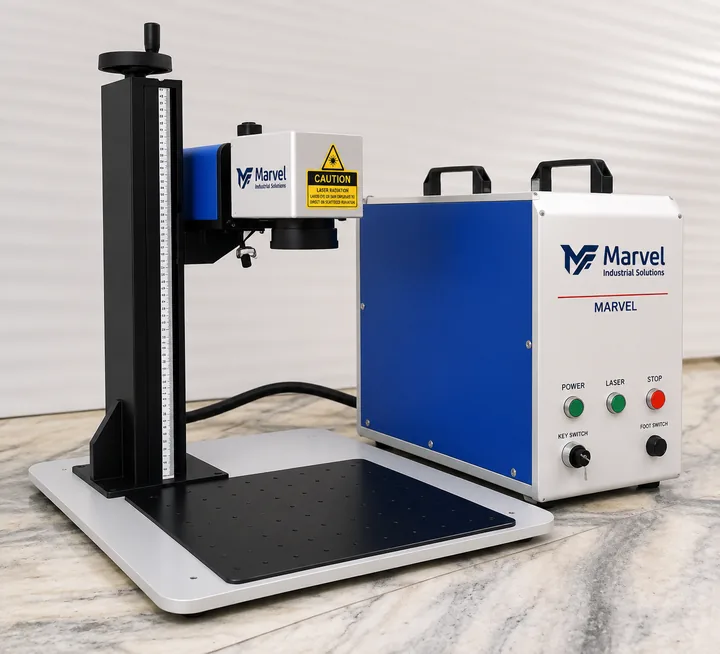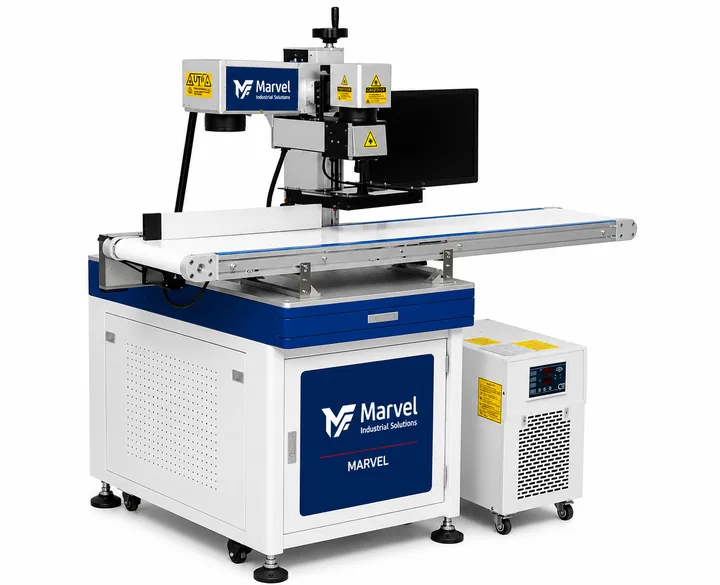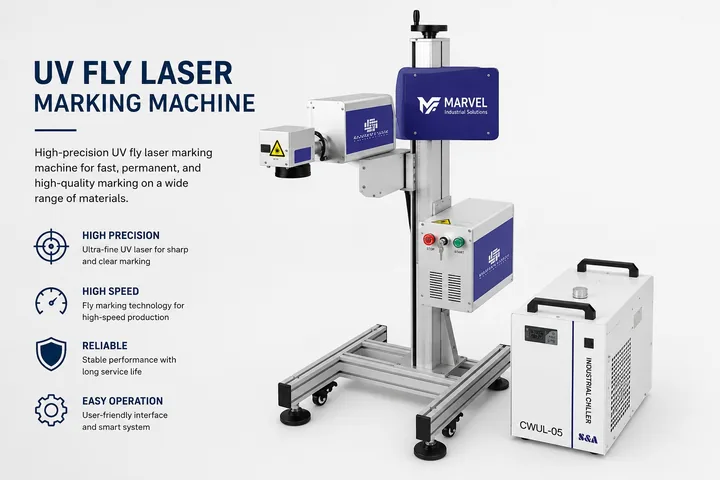
Standard Inline Flying UV Laser (3W / 5W)
Designed for medium-to-high speed bottling, FMCG, and cosmetic tube lines. Marks crisp expiration dates, batch codes, and logos on HDPE, PP, PET, and glass containers.
Engineered for 24/7 continuous production lines. Eliminate Inkjet (CIJ) consumables, overcome thermal plastic distortion, and achieve zero-contact, permanent 2D Data Matrix & barcode traceability at speeds up to 300 m/min.
In high-speed manufacturing environments—such as pharmaceutical packaging, beverage bottling, pipe extrusion, and medical device assembly—traditional coding methods like Continuous Inkjet (CIJ) and Thermal Inkjet (TIJ) introduce heavy operational friction: escalating solvent expenditures, printhead clogging, hazardous waste compliance, and smudged codes on hydrophobic polymers.
Conversely, conventional infrared lasers (Fiber at 1064nm and CO2 at 10.6µm) rely on photothermal heating. On heat-sensitive substrates like High-Density Polyethylene (HDPE), Polypropylene (PP), Polyethylene Terephthalate (PET), Teflon, and thin multilayer films, thermal lasers burn, melt, foam, or structurally compromise the part.
The UV Fly Laser Marking Machine overcomes these limitations through 355nm Third-Harmonic Generation (THG) laser physics. Utilizing high-energy ultraviolet photons, the system induces a photolytic photochemical reaction—breaking molecular bonds in polymers directly without thermal heat generation. This "cold processing" technique creates crisp, high-contrast, permanent microscopic marks without micro-cracking glass, burning foil, or causing structural swell on delicate plastics.
Engineered, assembled, and quality-tested at our manufacturing hub in Ahmedabad, India. Each machine configuration is optimized for continuous motion dynamics, line integration flexibility, and long optical component life.
Designed for medium-to-high speed bottling, FMCG, and cosmetic tube lines. Marks crisp expiration dates, batch codes, and logos on HDPE, PP, PET, and glass containers.
Heavy-duty laser engine designed for continuous pharmaceutical blister packaging, ampoule coding, and high-density 2D Data Matrix marking meeting GS1 standards.
Combines a 355nm UV cold laser with integrated industrial CCD camera vision system for dynamic part-position compensation, real-time OCR reading, and automatic rejection triggering.
Review engineering parameters to match laser power, optical lens focal length, and encoder resolution to your specific conveyor dynamics and substrate absorption characteristics.
| Parameter / Model | MIS-UV-FLY-3W | MIS-UV-FLY-5W | MIS-UV-FLY-10W | MIS-UV-FLY-15W |
|---|---|---|---|---|
| Laser Wavelength | 355 nm (Ultraviolet) | 355 nm (Ultraviolet) | 355 nm (Ultraviolet) | 355 nm (Ultraviolet) |
| Laser Source Type | Diode-Pumped Solid-State (DPSS) / Fiber UV | DPSS / Fiber UV | High-Power DPSS UV | Industrial Water-Cooled DPSS |
| Pulse Frequency Range | 20 kHz - 150 kHz | 20 kHz - 200 kHz | 30 kHz - 200 kHz | 30 kHz - 250 kHz |
| Max. Line Marking Speed | 120 meters/min | 180 meters/min | 260 meters/min | 300+ meters/min |
| Galvo Scanning Head | High-Speed Digital Scanhead | High-Speed Digital Scanhead | Ultra-Fast Digital Dual-Axis | Precision Optical Encoder Galvo |
| Standard Marking Field | 110 mm × 110 mm (F-160) | 110 mm × 110 mm / 150 mm × 150 mm | 110 mm × 110 mm / 175 mm × 175 mm | 150 mm × 150 mm / Custom |
| Min. Character Size | 0.15 mm | 0.12 mm | 0.10 mm | 0.08 mm |
| Speed Tracking (MOTF) | Rotary Shaft Encoder (10,000 PPR) | Rotary Shaft Encoder (10,000 PPR) | Dual Encoder / Differential Quadrature | EtherCAT High-Speed Bus Sync |
| Cooling System | Air Cooled / Internal Fan | Precision Air Cooled | Dual Air / Closed-Loop Chiller | Closed-Loop Industrial Water Chiller |
| Primary Target Materials | HDPE bottles, PET caps, PVC pipes | Cosmetic tubes, medical plastics, glass | Pharma blisters, cable jackets, silicon | Multi-lane fast packaging lines |
A 3-year Total Cost of Ownership (TCO) calculation for a continuous production line operating 2 shifts/day (4,000 hours/year) proves the massive cost advantage of inline laser coding.
| Cost Category | Continuous Inkjet Printer (CIJ) | Marvel UV Fly Laser Marking Machine | 3-Year Financial Impact |
|---|---|---|---|
| Initial Capital Expenditure (CapEx) | Moderate ($4,000 - $7,000) | Higher ($8,500 - $14,500) | Initial higher laser investment |
| Ink & Solvent Consumables | $4,500 - $7,500 / year per line | $0.00 (Zero Ink/Solvents) | Save $13,500 - $22,500 |
| Filter & Printhead Replacement | $1,200 / year | $0 (Solid-State Optics) | Save $3,600 |
| Unscheduled Line Downtime (Clogging) | 45 - 80 hours / year | Near Zero (< 2 hours / year) | Recovered production capacity |
| Hazardous Waste Disposal Fees | Required compliance fees | Zero hazardous waste | ESG & ISO 14001 Compliant |
| Code Smudging & Scrap Rate | 0.5% - 1.5% rejections due to wet ink | 0.00% (Instant permanent cold mark) | Substantial material scrap savings |
| Net 3-Year Operational Cost | $21,100 - $33,100+ | $800 - $1,500 (Electricity only) | Net Savings: $15,000+ per line |
As global supply chains transition toward Industry 4.0 and stringent ESG sustainability directives, procurement leaders must select laser platforms engineered for tomorrow's manufacturing standards.
Governments worldwide are phasing out volatile organic compounds (VOCs) and non-recyclable inks. The UV Fly Laser Marking Machine enables 100% inkless, chemical-free marking directly on mono-material recyclable plastics (PET, HDPE), satisfying EU Packaging and Packaging Waste Regulation (PPWR) mandates.
Future-ready UV fly laser installations incorporate integrated AI camera inspection. The system reads the marked 2D Data Matrix or barcode while the part is in motion, verifying GS1 grade quality, reading OCR text, and triggering high-speed air-blow rejectors without slowing the main line.
Modern pharmaceutical and automotive lines require dynamic serialization. Marvel UV fly laser controllers interface seamlessly via OPC-UA, Ethernet/IP, or TCP/IP protocols to pull variable serial numbers, manufacturing timestamps, and lot data directly from central ERP/MES databases in real time.
While nanosecond DPSS UV lasers remain the industry workhorse, ultra-short pulse (picosecond/femtosecond) UV lasers are entering high-precision micro-electronics and semiconductor wafer processing, offering virtually zero Heat-Affected Zone (HAZ) for microscopic circuit marking.
Understanding wavelength absorption is critical to achieving high-contrast laser marks. The 355nm UV photon energy is absorbed by a wide range of materials that reflect infrared wavelengths.
Produces rich black or bright white contrast marks on milk jugs, cosmetic bottles, and chemical drums without pinhole leaks or plastic swelling.
Marks clean micro-expiry codes on clear PET bottle necks and caps without blowing through the thin wall or creating weak structural points.
Delivers permanent frosted marks on clear and amber glass vials without surface micro-cracking, maintaining sterile structural integrity.
Inline continuous meter-marking on extruded electrical conduits, water pipes, and drip irrigation tubes at speeds up to 250 m/min.
Permanent code printing on Teflon, FEP, Fluoropolymer, and PVC aviation and automotive wire harnesses without damaging inner insulation.
Marks catheters, syringe barrels, and surgical components meeting ISO 10993 cytotoxicity and biocompatibility testing standards.
High-density 1mm x 1mm Data Matrix coding on flexible printed circuits and solder masks without layer delamination or electrical shorting.
Marks top lacquer layers on food and pharmaceutical sachets without compromising the aluminum moisture and barrier barrier integrity.
Answers curated by Marvel application engineers based on real global procurement queries, technical audits, and factory installations.
The 355nm ultraviolet wavelength operates via photo-chemical reaction (cold processing), breaking molecular bonds directly without generating intense thermal heat. Fiber (1064nm) and CO2 (10.6µm) lasers rely on thermal processing, which causes melting, burning, foaming, or structural damage on sensitive polymers like HDPE, PET, PVC, and silicon. UV laser marking delivers ultra-sharp, high-contrast marks with zero thermal deformation.
Depending on character size, code complexity (e.g., simple text vs. complex 2D Data Matrix), laser power (3W, 5W, 10W, 15W), and substrate absorption, Marvel UV Fly Laser Marking Machines achieve continuous inline speeds up to 300 meters per minute (approx. 18,000 to 45,000 units per hour). High-speed rotary optical encoders synchronize the galvo scanner in real-time to eliminate distortion during conveyor movement.
While CIJ printers require ongoing purchases of expensive inks, make-up solvents, filters, and frequent printhead cleaning shutdowns, a UV Fly Laser Marking Machine requires zero consumables. Capital expenditure is typically recovered within 8 to 14 months through savings on ink/solvents, reduced line downtime, zero hazardous chemical waste disposal fees, and elimination of code smudging.
Yes. Due to high photon energy at 355nm, UV light is readily absorbed by clear glass, quartz, thin multilayer films, thermoform blisters, and delicate medical silicone/PVC tubing. It produces clean, permanent frosted or dark micro-marks without micro-cracking glass or perforating thin plastic films.
Our UV fly laser systems connect to a high-resolution rotary shaft encoder installed on your production line or conveyor. The encoder feeds real-time velocity signals to the laser controller card. The galvo scanner dynamic algorithm automatically shifts character positioning in real time, ensuring perfectly spaced, un-distorted codes even if the conveyor speeds up, slows down, or stops mid-mark.
Maintenance is minimal compared to mechanical or inkjet markers. Routine tasks include checking and gently cleaning the protective optical window / F-theta lens from ambient factory dust, inspecting cooling airflow or chiller liquid levels, and validating optical alignment during scheduled preventive maintenance cycles.
Every Marvel UV fly laser system includes integrated safety interlocks, key-switch locks, emergency stop circuits, and protective optical shielding shrouds custom-fitted to your conveyor. We supply optical safety glass pass-through tunnels (Class 4 to Class 1 enclosure conversion) ensuring full compliance with international CE and OSHA laser safety standards.
At Marvel Industrial Solution, located in Gopal Charan Industrial Hub, Ahmedabad, Gujarat, India, we design, build, assemble, and test industrial laser machines and Special Purpose Machines (SPMs). Unlike trading vendors who simply rebox imported items, our engineering team manufactures complete laser cells—integrating rigid, stress-relieved structural frameworks, certified optical galvo heads, and customized conveyor pick-and-place automation systems.
Send us your line speed requirements, substrate specifications, and character height targets. Our optical application engineers will send you a tailored machine configuration, footprint drawing, sample cut/mark photos, and an honest ROI analysis.
Explore the engineering domains covered by Marvel Industrial Solution’s laser marking and automated special purpose machine platforms.